Infographic of UN Senior Leadership appointments
					Array
(
    [thumbnail] => https://s42831.pcdn.co/wp-content/uploads/2021/04/screen_shot_2021-04-05_at_5.03.46_pm_0-150x150.jpg.optimal.jpg
    [thumbnail-width] => 150
    [thumbnail-height] => 150
    [medium] => https://s42831.pcdn.co/wp-content/uploads/2021/04/screen_shot_2021-04-05_at_5.03.46_pm_0-300x168.jpg.optimal.jpg
    [medium-width] => 300
    [medium-height] => 168
    [medium_large] => https://s42831.pcdn.co/wp-content/uploads/2021/04/screen_shot_2021-04-05_at_5.03.46_pm_0-768x430.jpg.optimal.jpg
    [medium_large-width] => 768
    [medium_large-height] => 430
    [large] => https://s42831.pcdn.co/wp-content/uploads/2021/04/screen_shot_2021-04-05_at_5.03.46_pm_0-1024x573.jpg.optimal.jpg
    [large-width] => 1024
    [large-height] => 573
    [1536x1536] => https://s42831.pcdn.co/wp-content/uploads/2021/04/screen_shot_2021-04-05_at_5.03.46_pm_0.jpg.optimal.jpg
    [1536x1536-width] => 1238
    [1536x1536-height] => 693
    [2048x2048] => https://s42831.pcdn.co/wp-content/uploads/2021/04/screen_shot_2021-04-05_at_5.03.46_pm_0.jpg.optimal.jpg
    [2048x2048-width] => 1238
    [2048x2048-height] => 693
    [gform-image-choice-sm] => https://s42831.pcdn.co/wp-content/uploads/2021/04/screen_shot_2021-04-05_at_5.03.46_pm_0.jpg.optimal.jpg
    [gform-image-choice-sm-width] => 300
    [gform-image-choice-sm-height] => 168
    [gform-image-choice-md] => https://s42831.pcdn.co/wp-content/uploads/2021/04/screen_shot_2021-04-05_at_5.03.46_pm_0.jpg.optimal.jpg
    [gform-image-choice-md-width] => 400
    [gform-image-choice-md-height] => 224
    [gform-image-choice-lg] => https://s42831.pcdn.co/wp-content/uploads/2021/04/screen_shot_2021-04-05_at_5.03.46_pm_0.jpg.optimal.jpg
    [gform-image-choice-lg-width] => 600
    [gform-image-choice-lg-height] => 336
)
					

UN Senior Appointments: Looking Back at 2020

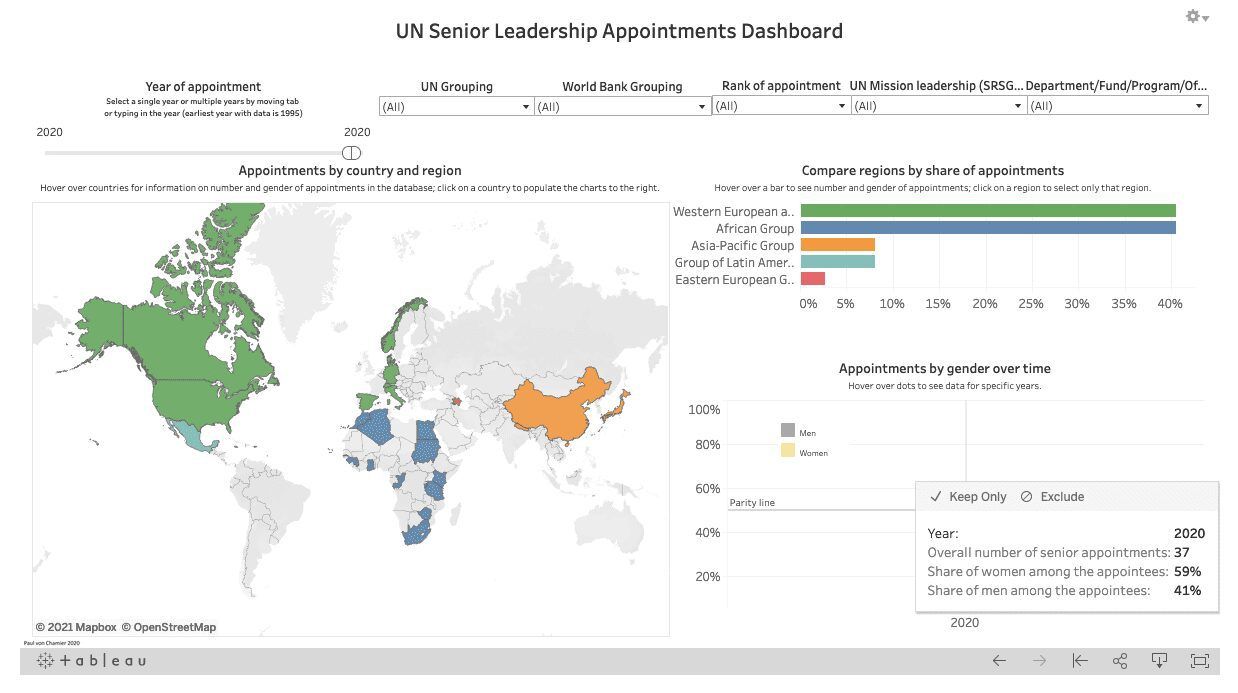
Last fall, with the launch of our UN Senior Leadership Appointments Dashboard, we were able to quantify the “halting progress” on gender parity at the UN. We are pleased to announce that we have updated the dashboard to include all the data from the year 2020—and that the progress continues. While this article highlights some of our key headlines from 2020, we encourage you to explore the updated dashboard and the varied analysis it offers.

Assistant and Under-Secretaries-General

Last year, the UN only appointed thirty-seven people at the assistant secretary-general and under-secretary-general (ASG/USG) rank, as tracked by the dashboard. By contrast, over the past decade, the annual average has been around sixty people. (Curious minds might ask why this is so—for example, is it due to a difficulty in filling vacancies during COVID-19, or a lower rate of turnover in senior roles relative to other years?) Twenty-two of these appointees, or 59 percent, were female, which is consistent with the accelerated upward dynamic of the ratio of women in the senior-most roles at the UN since 2017. This proportion was even higher among appointees from low- and low-middle income countries (for example, in 75 percent of the appointments from low-income countries, three out of the total of four, were women).

Mission Leadership

The proportion of women was even higher when looking at mission leadership, in particular special representatives and deputy special representatives of the secretary-general (SRSG/DSRSG) appointments. There, 70 percent of the appointees were female in 2020. The upward dynamic of women’s share in this type of senior appointments started around 2017, later than for the UN as a whole, but has progressed at a much faster pace, defying stereotypes about the character of roles assigned to senior women leaders. However, women are still likelier to be assigned a deputy special representative role rather than a more prominent special representative one. In 2020, 60 percent of the female SRSG/DSRSG appointments were at the deputy level, consistent with preceding years.

While analyzing these insights, it is important to distinguish between the proportion of women among the new ASG/USG appointees, which the dashboard reports on, and their proportion among all the ASGs/USGs currently serving at the UN. Data from the UN Secretariat Gender Parity Dashboard, which tracks the latter, reveals a gender-balanced composition among the USGs and ASGs positions with 51 percent held by men and 49 percent by women.

Regional Representation

In terms of regional representation, the African UN grouping saw the biggest gain in terms of the proportion of the appointments in 2020 compared to its average share over all twenty-six years of the data covered by the dashboard. Around one third of the appointees came from the African region, as compared to less than one fourth during the whole analyzed period. Simultaneously, the UN Grouping representing nations labeled as Western European and Others experienced a decline from 48 percent of appointments to 39 percent. Shares of other regional groups were comparable to their long-term averages.

We look forward to reporting again soon on early findings from 2021, to see if the trends are still holding.

Visit the UN Senior Appointments Dashboard

  • Press Release October 22, 2020 Promoting and Defending Multilateralism

    Press Release: Launch of the UN Senior Leadership Appointments Dashboard

    The Center on International Cooperation and the Center for Global Affairs at NYU are launching an online dashboard aimed at tracking diversity at the leadership level for the United Nations. The new UN Senior Leadership Appointments Dashboard collates information issued as press releases by the UN about appointments of its most senior leaders since 1996, tracking various measures of diversity including gender, national origin, age, and educational background.

  • Blog June 22, 2020 Promoting and Defending Multilateralism

    Senior Appointments at the UN: Using Data for Greater Transparency

    The NYU Center on International Cooperation (CIC) and NYU Center for Global Affairs (CGA) have been working together since 2017 to independently monitor implementation of the strategy. As one piece of this work, we have focused on developing a richer understanding of UN senior appointments (assistant secretary-generals, undersecretary-generals, and deputy secretary-generals), including gender and other demographic dimensions. To do this, we have collected data from press releases on the UN’s website, allowing us to gain insights on the strategy’s progress and produce an interactive database on current and past patterns in senior appointments, which will be launched in September 2020.

    • Paul Von Chamier
    Paul von Chamier, Foteini Papagioti

Stay Connected

Subscribe to our newsletter and receive regular updates on our latest events, analysis, and resources.

"*" indicates required fields

This field is for validation purposes and should be left unchanged.