CIC's Work on Artificial Intelligence

With the rapid advancement and uptake of emerging technologies, programs across CIC are working to analyze the influence of Artificial Intelligence (AI) on global policymaking, including understanding new challenges and risks, how to mitigate them, and how to support its positive impacts. Explore this page to learn more about our work on AI in conflict prevention, global governance, justice, and the Sustainable Development Goals (SDGs).

Hand holding a black and white ornament against a backdrop.

AI + Violence Prevention

Building on CIC’s past research on risk and protective factors, CIC is exploring how to develop a new AI tool. This includes developing an improved methodology to provide decision-makers with real-time insights into sources of conflict and resilience. This will enable them to map gaps in their prevention architecture, identify where international partners can contribute in a more targeted, timely, and impactful way, and adapt as conditions evolve.

  • Develop a diagnostic tool that gives decision-makers real-time insights into national violent conflict risks and sources of resilience.

Reach out to Luisa Portugal and Céline Monnier for any questions.

Photo of a globe in dim lighting

Multilateral AI Governance

The Multilateral Reform program’s AI governance work focuses on strengthening coherence within this emerging architecture. The program examines how mandates interact, how processes evolve, and how institutional design choices shape the effectiveness of UN-mandated mechanisms. This includes mapping the UN AI ecosystem, engaging directly with Member States and UN entities to clarify roles and entry points for engagement, and providing structured ideas to support the development of processes such as the Global Dialogue.

Reach out to Joris de Mooij for any questions.

Multilateral AI Governance
Lines of vertical code in green over a black background.

AI + People-Centered Justice

CIC’s emerging technology, artificial intelligence, and justice portfolio operates on two core assumptions:

  • Strong, well-designed legal systems, with the principle of equal access to justice for all at the center, can support a more balanced, inclusive, and equitable AI revolution, while increasing access to the benefits of technology for everyone. This includes benefiting private markets in a way that supports public benefit from private innovation.
  • Reciprocally, an inclusive and equitable AI revolution could increase equal access to justice for all.

Based on these core assumptions, and leveraging multistakeholder networks of public, private, multilateral, civil society, and academic experts, CIC has the following focus areas related to justice:

    • Identify and profile access-to-justice interventions that support prosocial and responsible outcomes related to emerging AI and technology. In parallel, identify and profile AI and emerging technology interventions that support positive access to justice outcomes.
    • Facilitate greater collaboration between public and private actors to support equitable access to technology innovations for access to justice.
    • Provide evidence-based policy guidance to support decision-makers working at the nexus of justice and AI, prioritizing cross-sector discourse, collaboration, learning, and action.

Reach out to Nate Edwards for any questions.

A globe surrounded by colorful symbols representing the 17 Sustainable Development Goals, set against a lush green forest backdrop.

AI + the Sustainable Development Goals

To leverage the positive potential of AI, the multilateral system needs to utilize the tools already at its disposal. These tools enable the establishment of normative frameworks, the institutionalization of universal values, and the facilitation of collective action among diverse stakeholders. In particular, years of research, policy frameworks, partnership development, and programming aimed at advancing the Sustainable Development Agenda (Agenda 2030) could be an asset for maximizing the potential of the AI revolution. These longstanding efforts will not only benefit from new technologies, but they also offer tributaries by which the positive potential of AI can flow.

Reach out to Laura Powers for any questions.

Related Resources

  • Blog May 25, 2026

    Why Effective AI Governance Depends on Strong Justice Systems

    As governments rush to regulate AI, many governance frameworks still overlook what happens when people are harmed. This piece argues that AI governance will be tested by legal systems already struggling to deliver equal access to justice. Drawing on the recent report "A People-Centered Justice Approach to Implementing AI Governance," examples from Australia, the Netherlands, and the United States make the case for bringing courts, legal aid organizations, and justice institutions into the center of AI governance design.

    Headshot of Nate Edwards.
    Nate Edwards
  • Meeting Report March 23, 2026

    21 Lessons from an Expert Discussion on Artificial Intelligence (AI), Governance, and People-Centered Justice

    This hybrid meeting brought together over 200 representatives from government, the legal field, international organizations, private sector, and civil society to explore two interconnected issues: 1) How the justice sector can support a more equitable, inclusive, and enforceable AI governance, and 2) how AI can help deliver better justice outcomes for people.

  • Blog December 11, 2025

    Building Trust in AI through Justice

    As AI rapidly enters public services, concerns about transparency, accountability, and fairness are colliding with an already-deepening global trust deficit. This tension is particularly visible in justice systems, where millions interact most directly with the state. This piece explores why the justice sector is a critical proving ground for trustworthy AI, and what’s at stake for democracies if governments fail to get it right.

    Headshot of Nate Edwards.
    Nate Edwards
  • Publication: Policy Brief March 9, 2026

    A People-Centered Justice Approach to Implementing AI Governance: How the Justice Sector Can Support Inclusive, Equitable, and Enforceable AI Governance

    This paper provides the latest state analysis of AI governance and how the justice sector can enhance its success. The authors couple secondary research and primary analysis of key governance processes with input from an array of experts in the public and private sectors, multilateralism, civil society, and academia to explore two critical questions:

  • Article December 24, 2025

    Safeguarding Human Rights and Judicial Independence in the Age of Algorithmic Justice

    The rapid integration of artificial intelligence (AI) in court systems promises greater efficiency and improved access to justice. Yet, it brings profound risks. Errors, biases, or overreliance on algorithms may undermine judicial independence and human rights. How can judges maintain control over technology while ensuring justice remains human-centered?

    Headshot of a person wearing a purple suit and red tie with white background.
    Themba Mahleka
  • Blog October 2, 2024

    Building Peaceful, Just and Inclusive Societies In the Digital Realm

    In this blog, the three Pathfinders Program Directors at NYU’s Center on International Cooperation (CIC) analyze the possible impacts of the recently adopted Global Digital Compact (GDC) on the advancement and implementation of SDG16. They also examine how the Compact aligns with ongoing efforts within the Pathfinders’ three Grand Challenges to build peaceful, just, and inclusive societies.

    • Headshot of a bearded, dark-haired man in a black suit, white shirt, and red tie leaning against a textured chartreuse wall and smiling at the camera.
    • Headshot of a person smiling in front of a white background wearing a suit and blue tie.
    • Swati Mehta
    Daniel Friedman, Fernando Marani, Swati Mehta
  • Blog April 4, 2024 Inequality and Exclusion

    Fostering Inclusivity in the Digital Era: Two Priorities for the UN’s New Global Digital Compact

    The ongoing negotiations of the Global Digital Compact (GDC) at the United Nations (UN) in New York, under the leadership of Sweden and Zambia, presents member states with a unique opportunity  to deliver tangible change in people's lives by closing the digital divides. The GDC also holds the promise of ensuring a safer future for all by addressing fragmentation and critical gaps in the global governance of the digital space, including on AI and other emerging technologies.

    Headshot of a person smiling in front of a white background wearing a suit and blue tie.
    Fernando Marani
  • Statements September 19, 2025 Pathfinders

    UNGA80: A Crossroads for Peace, Justice, and Inclusion

    As world leaders continue to gather in New York for the 80th session of the United Nations (UN) General Assembly, Pathfinders for Peaceful, Just and Inclusive Societies will continue to engage with governments on how to respond to some of the converging crises of our time—inequality, sovereign debt distress, violence and conflict, climate change, global justice gap, democratic backsliding, and trust in institutions at all levels.

  • Publication: Report April 6, 2022 Data for Peace

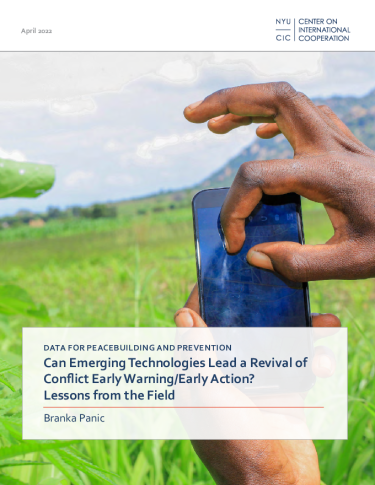
    Can Emerging Technologies Lead a Revival of Conflict Early Warning/Early Action? Lessons from the Field

    The early warning/early action (EWEA) community has been working for decades on analytics to help prevent conflict. The field has evolved significantly since its inception in the 1970s and 80s. The systems have served with variable success to predict conflict trends, alert communities to risk, inform decision makers, provide inputs to action strategies, and initiate a response to violent conflict. Present systems must now address the increasingly complex and protracted nature of conflicts in which factors previously considered peripheral have become core elements in conflict dynamics.

  • Blog December 9, 2020 Data for Peace

    Emerging Technologies: The Ally Human Rights Advocates Need

    Human rights have increasingly been impacted by the development of emerging technologies, which have raised many problematic issues in previous years. Many of the issues are not new, but they are greatly exacerbated by the scale and proliferation of AI, big data, and the rise of algorithmic decision-making.

    Branka Panic
    Branka Panic
  • Publication: Report July 14, 2022 Data for Peace

    Towards a Prevention and Peacebuilding Data Hub: Scoping the Future of Data Services and Capacity Building

    The complex crises in our world—from rising instability linked to pandemic effects and climate change, to ongoing challenges of civil war, urban violence, violent extremism—require complex analysis and insights. Emerging technologies, data, and data science methods have been recognized as potential tools to help tackle some of these “wicked” problems across the humanitarian-development-peace nexus.

  • Video November 9, 2023 Data for Peace

    Mapping with Communities and Artificial Intelligence

    This session was part of the Data for Peace 2023: Using Data to Foster Peace Conference over October 16-20, 2023, a five-day hybrid event with national and international experts in the data for peacebuilding and prevention ecosystem to facilitate peer-to-peer exchange and leverage emerging technologies and data science methods to tackle the growing challenges across the humanitarian-development-peace and climate nexus globally. This event was hosted by the NYU Center on International Cooperation and supported by the Complex Risk Analytics Fund (CRAF’d) and its partners, with the in-person segment of the event hosted at Google's NYC office.

  • Video July 29, 2021

    Data for Peace Dialogue: Using AI for Fighting Modern Slavery - Lessons for Peacebuilding

    Over 40 million people today are trapped in modern slavery and conditions of severe exploitation worldwide. One in four of them are children, and almost 71 percent are women and girls. Governments are already behind in their commitment to eradicate modern slavery and achieve UN Sustainable Development Goal 8.7 by 2030. Data about this form of human rights abuses and vulnerabilities can be difficult to collect and patterns of exploitation difficult to see. On top of that, armed conflict, natural disasters, and other humanitarian settings increase vulnerability to certain forms of forced labor, modern slavery, human trafficking, and child labor. In response, some organizations and researchers are looking into available data and the potential of computational science, artificial intelligence, and machine learning tools to help stop modern slavery.

Related Centers and Departments at New York University

Stay Connected

Subscribe to our newsletter and receive regular updates on our latest events, analysis, and resources.

"*" indicates required fields

This field is for validation purposes and should be left unchanged.
]