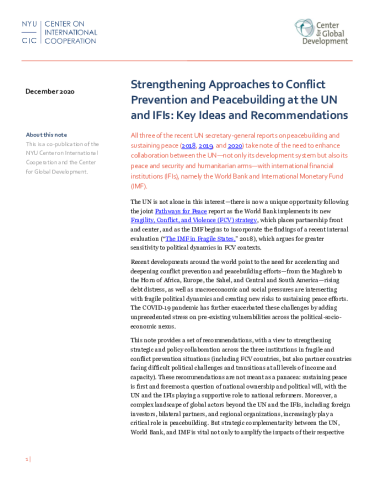
All three of the recent UN secretary-general reports on peacebuilding and sustaining peace (2018, 2019, and 2020) take note of the need to enhance collaboration between the UN—not only its development system but also its peace and security and humanitarian arms—with international financial institutions (IFIs), namely the World Bank and International Monetary Fund (IMF).
Recent developments around the world point to the need for accelerating and deepening conflict prevention and peacebuilding efforts—from the Maghreb to the Horn of Africa, Europe, the Sahel, and Central and South America—rising debt distress, as well as macroeconomic and social pressures are intersecting with fragile political dynamics and creating new risks to sustaining peace efforts. The COVID-19 pandemic has further exacerbated these challenges by adding unprecedented stress on pre-existing vulnerabilities across the political-socio-economic nexus. This note provides a set of recommendations, with a view to strengthening strategic and policy collaboration across the three institutions in fragile and conflict prevention situations. These recommendations are based upon a policy dialogue in November 2019 between the three institutions, and a series of four country-focused dialogues in May and June 2020 between UN, World Bank, and IMF representatives.
All these meetings were co-convened and supported by the Center on International Cooperation (CIC) at New York University and the Center for Global Development (CGD).
Download the full note here.
Other papers in the UN-IFI policy briefing series:
- Paige Arthur, A Stocktaking of the UN-IFI Relationship on Prevention and Peacebuilding, 2018 to 2020
- Marc Jacquand, A Summary of UN-IFI Institutional Arrangements in FCV Contexts
- Marc Jacquand, Opportunities and Challenges for Greater IFI-UN Collaboration Across Macroeconomic/FCV linkages (October 13)