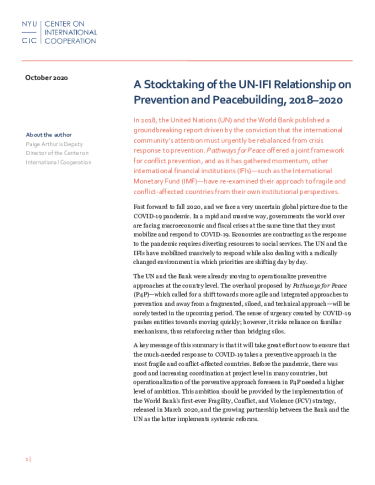
In 2018, the United Nations (UN) and the World Bank published a groundbreaking report driven by the conviction that the international community’s attention must urgently be rebalanced from crisis response to prevention. Pathways for Peace offered a joint framework for conflict prevention, and as it has gathered momentum, other international financial institutions (IFIs)—such as the International Monetary Fund (IMF)— have re-examined their approach to fragile and conflict-affected countries.
Now, with the UN and the IFIs mobilizing in response to the COVID-19, the progress made in recent years will be tested. There is a risk that these opportunities will be overshadowed by the colossal need generated by the pandemic—but the scale and urgency of the crisis is also creating new opportunities for UN-IFI collaboration. This briefing provides an external perspective on the evolution of the UN-IFI relationship over the past three years. The first part of the stocktaking will focus on the UN-World Bank relationship, followed by a brief overview of partnership with the IMF. It is written for a broad audience—across the UN system, the World Bank and other IFIs, UN member states, civil society, and beyond—and aims to build consensus on next steps needed to accelerate implementation of a preventive approach.
Download the briefing here.
Other papers in the UN-IFI policy briefing series:
- Sarah Cliffe, Paige Arthur, Leah Zamore, Strengthening Approaches to Conflict Prevention and Peacebuilding at the UN and IFIs: Key Ideas and Recommendations
- Marc Jacquand, Opportunities and Challenges for Greater IFI-UN Collaboration Across Macroeconomic/FCV Linkages
- Marc Jacquand, A Summary of UN-IFI Institutional Arrangements and Instruments in FCV Contexts