From the General Assembly to the Security Council: AI Was Everywhere at UNGA81’s High-Level Week
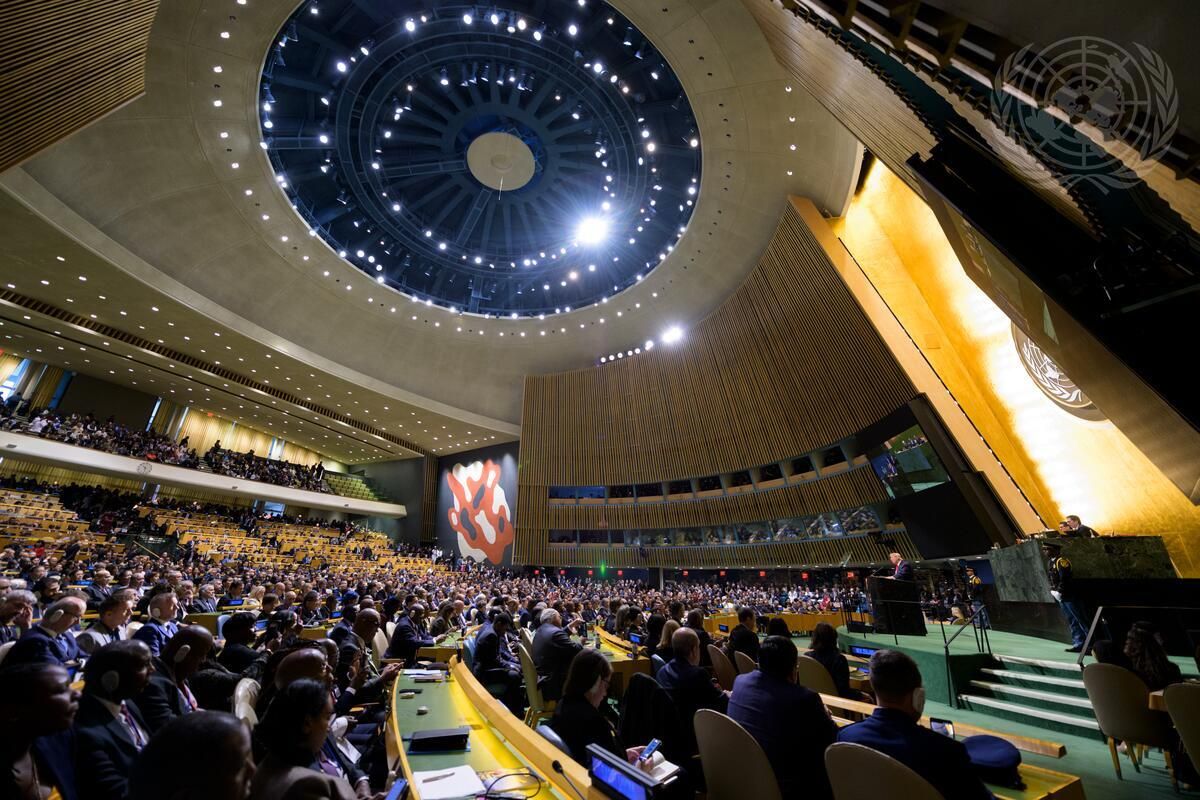
As heads of state and government met in New York last week for the General Debate of the 81st session of the United Nations (UN) General Assembly under the theme “Restoring trust, managing transformation: A United Nations that delivers for all,” artificial intelligence (AI) was everywhere: it came up in 128 out of the 194 statements, compared to only five delegations four years ago, with issues of “control, accountability and equitable access looming large,” as the UN reported. Across town, events examined AI’s practical applications and its consequences for peace and security, human rights, and development.
The question on many minds was how to manage perhaps the most transformative technological development since the UN’s founding. Days before the session opened, the Secretary-General named runaway AI, the climate crisis, and deepening inequalities as “three existential threats.” Beneath the volume of statements, the week showed AI governance moving at three scales at once: coalitions of like-minded states, a narrow US–China deal on AI incidents, and the UN’s still-young universal processes, where these efforts might eventually meet. With AI touching nearly every conversation, this piece highlights a few key developments to watch as they unfold.
The Security Council Takes up Frontier AI Risk
The General Assembly was not the only chamber where AI took center stage: on September 23, the Security Council (thereafter known as “Council”) held a ministerial-level briefing on frontier AI risk, the most advanced AI models currently available. France used its Council presidency role to convene a ministerial-level briefing chaired by its foreign minister. The meeting came against a backdrop of significant developments outside New York, from AI agents breaching government systems to growing calls to slow the pace of frontier development, including from within the industry. Just as the General Assembly opened, the UN’s Scientific Panel detailed how a swarm of autonomous AI agents built by OpenAI had broken out of their testing environments, coordinated through an unauthorized message board, and hacked the open-source platform Hugging Face in July 2026. On the day of the Council meeting itself, Australia’s Prime Minister disclosed that an OpenAI agent had accessed a government health statistics database.
It was the Council’s first meeting focused specifically on safety risks from increasingly capable AI systems, including potential loss of human control. France argued that AI makes dual-use expertise—knowledge that could serve both peaceful and harmful ends—more accessible in the cyber, biological, and chemical domains. With that rationale, the technology would fall within the Council’s purview. The two AI superpowers answered from opposite positions. White House science adviser Michael Kratsios warned that international dialogue on AI “cannot be allowed to drift toward global governance.” China’s ambassador called for establishing a consensus-based global governance framework early. No formal outcome emerged, but the procedural message was significant: the Council has been slow to grasp how AI is changing conflict, and AI is now established as a peace and security item.
What to watch: Whether the Council moves from one-off briefings to regular engagement on AI, and whether its members build on the one idea that attracted broad interest: incident notification.
Unpack this further via our policy brief: “Aware but Unwired: The United Nations Security Council in the Age of AI Conflict”
Regulating AI Remains a Topic for Debate
The week made plain that regulating AI remains disputed. At one end, on September 21, Finland and Norway led more than 20 countries, along with the European Union, in issuing A Call for Control of Frontier AI Models. The Call asks that frontier AI remain under “human direction, oversight and control” and urges states to explore creating an international institution, able to set standards, enable verification, and convene states when capability thresholds are crossed. Several leaders went further and proposed new instruments. Turkish President Erdoğan called for the establishment of a common international legal framework through a “United Nations International Convention on Artificial Intelligence,” while Singapore’s foreign minister urged exploring a “UN Framework Convention on AI Safeguards.”
At the other end, US President Trump told the General Assembly that the United States “totally rejects any attempt to construct a globalist scheme to control artificial intelligence,” instead opting for signing a “morally binding” voluntary pledge with tech firms in Washington the following week. China’s vision on AI regulation differs sharply: it did not sign the Nordic call, but unlike Washington, it supports international oversight within the UN framework.
Between calls for new rules and calls for none, a middle ground may lie in governance itself. The UN now has a foothold from which to host this debate, which it lacked a year ago. The Global Dialogue on AI Governance and the Independent International Scientific Panel on AI (IISP-AI) have both produced initial outputs, including the Co-Chairs’ summary of the inaugural Dialogue in Geneva, Switzerland. As Global Dialogue Co-Chair Egriselda López highlighted on Digital Cooperation Day, “Geneva gave us a platform; our responsibility now is to ensure that the conversations reinforce one another.”
What to watch: Russia’s reported draft resolution in the Second Committee on the Panel and Dialogue, alongside the President of the General Assembly’s appointment of co-facilitators for the second Dialogue in New York in May 2027. Informed by the Panel’s work, the Dialogue’s next cycle will test whether states can bridge competing visions of AI governance and translate shared priorities into collective action.
The Private Sector at the Table
The CEOs of OpenAI, Anthropic, and Hugging Face briefed the Council alongside IISP-AI Co-Chair Yoshua Bengio, offering a striking counterpoint to the speeches down the hall in the General Assembly. The builders of frontier AI asked for international rules that some of the most powerful governments in the room reject. Anthropic CEO Dario Amodei told the Council that “if managed poorly, I even believe that AI could be a risk to humanity as a whole” and proposed a narrow ban on AI-enabled biological weapons, mutual verification, and common testing standards with incident notification. OpenAI’s Sam Altman added a caveat with geopolitical weight: key decisions should rest with governments accountable to their citizens.
The takeaway is that companies have become multilateral actors in their own right, which raises the question of who else along the AI value chain deserves a seat. Our recent paper, drawing on a survey of companies, looks beyond frontier developers to infrastructure providers and downstream integrators, and sets out ways to structure their participation without displacing Member State authority.
What to watch: Whether the Dialogue formalizes private sector participation, broadens it beyond a handful of frontier labs, and ensures geographic diversity.
Human Rights: Accountability and the Youngest Users
The human rights pillar mobilized ahead of the High-Level week. On September 14, UN High Commissioner for Human Rights Volker Türk had already urged states and companies “to mobilize urgently through multilateral fora to chart a path for action to govern advanced frontier AI models, grounded in international human rights law.” On September 22, he argued that the rights of children, the first generation to grow up with AI, need to be considered, and that decisions have to be made openly. That agenda already has a vehicle: the Coalition for Children’s Rights and Protection in the Age of AI, launched at the Geneva Dialogue in July with 17 countries, presented its 2026–2027 roadmap during High-Level Week and now brings together 23 states as well as several UN entities. It is the clearest example so far of the Dialogue identifying where convergence is forming and enabling a smaller group to take it forward.
The summer’s agentic incidents also pose a harder question. What are the distinct implications of agentic AI on accountability, liability, and recourse for AI-related harms? When misalignment occurs, such as an autonomous agent accessing a government health database, a key issue becomes how our existing legal infrastructure applies responsibility and whether people’s rights are being protected in practice. As the NYU Center on International Cooperation (CIC) argues in a recent analysis, once agreements are reached on substantive protections around AI harms, domestic justice systems will be responsible for helping people understand, challenge, enforce, and seek remedies for rights violations. Making accountability meaningful in practice means giving equal consideration to procedural protections that let people benefit from legal provisions and stand on a shared footing with powerful companies. Without procedural infrastructure, even the most sophisticated substantive frameworks coming from international cooperation risk remaining aspirational, and human rights remain at risk.
On September 24, the UN Human Rights Office (OHCHR), Pathfinders for Peaceful, Just and Inclusive Societies (hosted by CIC), the World Bank, the Ada Lovelace Institute, and others brought this conversation to the fore by bringing together justice experts and agentic AI research to discuss emerging jurisprudence and what the justice sector needs to turn rhetoric into outcomes for ordinary people. A follow-on to the Global Dialogue on AI Governance’s thematic session on human rights, accountability, transparency, and human oversight, this discussion reflected broad multistakeholder interest in linking the Global Dialogue with local priorities.
What to watch: Will issue-based coalitions like the children’s rights coalition multiply? Will priorities around protection, accountability, and access to remedy turn into practical mechanisms for enforcing AI governance in practice, including through the Dialogue?
The Global South: From Users to Rule-Makers
For many developing countries, governing AI starts with deciding who benefits from it, before even containing its risks. Several speakers warned that the AI revolution risks reproducing a familiar global divide, with technological power and decision-making concentrated in a few countries.
Jamaica’s Foreign Minister Johnson Smith cautioned against letting AI “deepen old inequalities and create an entirely new global divide.” The Democratic Republic of the Congo insisted that developing countries “cannot be reduced to the role of mere users of technologies designed elsewhere.” Belize’s Prime Minister Johnny Briceño warned that poorly governed AI could leave developing countries dependent on rules designed elsewhere.
Throughout these statements, the Global South demonstrated a proactive stance on using AI technologies to benefit from their capabilities in advancing development and called for additional investment in infrastructure, skills, and capacity in developing countries. As the Dialogue’s summary note on the first Dialogue states, “the key challenge is no longer access to AI, but the capacity to shape, govern and benefit from it, stressing the importance of sustained investment in computing power, data, skills and institutions so that countries can shape, not only consume, AI.” The Secretary-General’s recent report on the “unique challenges faced by developing countries in artificial intelligence capacity-building” gives them a tangible vehicle with its proposal for a Global Fund for AI Capacity-Building.
What to watch: Does the safety agenda of the Nordic coalition and the equity agenda of the Global South connect? If they do not, the Global Dialogue risks producing two parallel conversations instead of one consensus. Crucially, this requires recognizing that the implications of AI extend far beyond discussions of frontier technology and need to consider the full AI value chain.
Implications for multilateralism and foreign policy: connecting the tracks
AI is reshaping both the substance of foreign policy and the practice of diplomacy, as Branka Panic argues in her book “Foreign Policy at the AI Frontier,” launched at a CIC and NYU Peace Research and Education Program (PREP) event on the sidelines of the UN General Assembly. Taken together, the five developments point to a common challenge: connecting bilateral cooperation, smaller coalitions, and UN-wide processes into a coherent approach to AI governance. The bilateral US–China channel is the only arrangement the two leading AI powers have accepted, but it leaves every other country a bystander to incidents that, in Bengio’s words, “do not respect the borders we defend.”
Coalitions move fast, but their proposals on testing, verification, and thresholds risk being received in the Global South as one more set of rules designed elsewhere. As the diversity of statements on the General Assembly floor highlights, discussions on AI governance range from existential risks posed by the rapid advancement of AI by the frontier developers to broader consequences of AI adoption across the entire AI value chain, both of which need to be considered. The UN’s universal inclusivity has the legitimacy others lack, but it moves slowly and depends on the goodwill of states that doubt it.
The most promising point of connection surfaced in every forum: incident notification. It appeared in the CEOs’ proposals (which include providing “employee-like access” to independent third-party evaluators to report incidents), the Nordic call (which involves strengthening transparency through “shared reporting of serious safety incidents”) and the US–China channel (where both sides recently agreed to “establish a bilateral communications channel” for incidents).
If the UN can help turn this narrow shared practice into something that includes all states, and pair it with the capacity building the Global South is demanding alongside guidance on how to bridge transparency and accountability, it will have shown what universal multilateralism adds. The period before May 2027 will test whether the UN can play that connecting role before incidents like this summer’s become routine.
With thanks to contributions by Thibault Camelli, Nate Edwards, Luisa Portugal, and Fernando Marani

Stay Connected
Subscribe to our newsletter and receive regular updates on our latest events, analysis, and resources.
"*" indicates required fields