
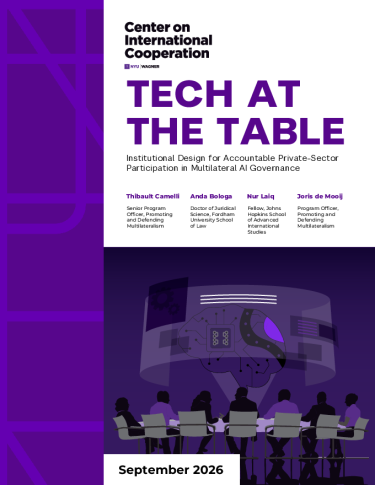
Tech at the Table
This paper examines how private-sector participation in multilateral artificial intelligence (AI) governance can be structured to support knowledge, accountability, and implementation.
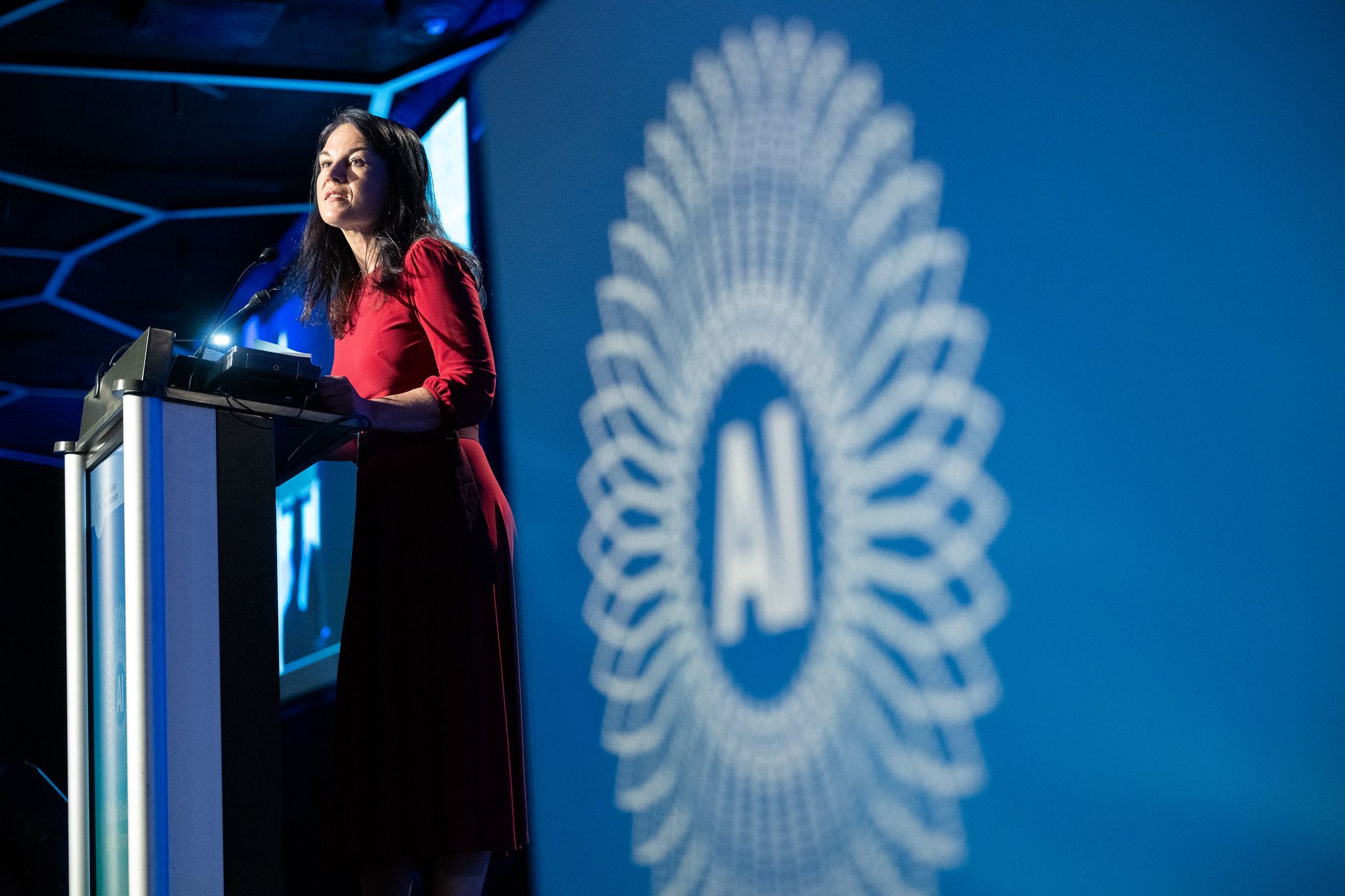
The debate over artificial intelligence (AI) governance has intensified sharply in recent weeks, with leading researchers and technology executives publicly warning about the risks posed by increasingly capable systems and disagreeing over whether their development should slow. No matter where the trajectory of the technology ends up, this debate underscores a growing governance challenge.
AI is developing across borders, and at the same time, governments and companies are not in consensus about risks, safeguards required, and who should set them.
Against this backdrop, the United Nations’ Global Dialogue on AI Governance (thereafter known as “Global Dialogue” or “Dialogue”) provides one of the few forums where these questions can be addressed through a universal political process. Its first cycle has now concluded with the Co-Chairs of the inaugural Global Dialogue on AI Governance having finalized the first chapter of the new member state-led process through the release of the summary note on September 8, 2026. The Global Dialogue launched in September 2025, included months of consultations across multiple continents, and culminated in a two-day session in Geneva this past July. The Co-Chairs H.E. Egriselda López (El Salvador) and H.E. Rein Tammsaar (Estonia) concluded their mandate with an 18-page summary outlining how the process unfolded, and where it should go from here.
Attention now turns to the second Dialogue, scheduled for New York on May 3-4, 2027. The first cycle put a universal process in place, tested its format, and identified areas of broad convergence. The second will have to go further, with its Co-Chairs expected to work towards common understandings on priority areas for international AI governance. What happens between now and then, during the inter-sessional period, will determine whether the Dialogue can convert broad participation into common political understanding.
The summary note offers a useful guide for what comes next by identifying convergences to build on and gaps still to close, which the next Co-Chairs, member states, and other stakeholders should all take into account as they begin to design the Second Dialogue and the upcoming inter-sessional period.
The first Dialogue demonstrated what the UN distinctively brings to the emerging AI governance architecture, while also illustrating the central tension at the heart of any universal process: the inclusivity that gives it legitimacy makes substantive convergence more difficult.
In the summary, the Co-Chairs directly made the case for the value of this process. As they put it, “no single government, company or institution can govern AI alone,” and the UN “offers a distinctive platform for that work.” What makes the UN’s contribution to global AI governance discourse distinctive is not convening alone.
Multiple AI governance convenings already take place across a range of international forums and processes, including the G7’s Hiroshima AI Process, the Organisation for Economic Co-operation and Development (OECD)’s AI governance work, as well as successive high-level AI summits held in the United Kingdom, South Korea, France and India. The UN’s comparative advantage lies in its combined force of universality and political legitimacy, and the ability to bring all countries into formally equal terms, alongside public stakeholder participation which includes civil society, academica, and industry. Its very source of legitimacy simultaneously creates its greatest challenge, which is the difficulty of finding ways for all countries to move beyond the lowest common denominator.
Among the recurring themes highlighted by the co-chairs, the protection of children from AI-related harms stood out. In the conversations leading up to the dialogue, it became clear that this was an area where member states were all willing to engage with. In Geneva, the Coalition for Children’s Rights and Protection in the Age of Artificial Intelligence, currently comprised 17 countries and various UN entities, was launched, followed by the UN Secretary-General António Guterres announcing the child safety pledge.
This emerging action is exactly how the Dialogue can produce a concrete value-add for the wider ecosystem. Through organizing a series of consultations, an area of convergence began to appear, the co-chairs took note and created space for further discussions. Ultimately, a set of countries took the initiative to build a concrete coalition demonstrating how the broader ecosystem can evolve from this process. An issue can gain political visibility through a universal process while interested states, UN entities, and other actors pursue more concrete forms of cooperation around it.
The inter-sessional period now provides an opportunity to continue advancing this agenda by engaging more countries and working with various stakeholders to move this agenda into action. The next co-chairs should provide as much space as possible to enable the advancement of this initiative, and to capitalize on other openings like it that arise through consultations. Multilingualism may provide one such area.
The lesson here is not that the Dialogue must generate every outcome itself. Its more realistic and valuable function may be to identify where convergence is forming, give it visibility, and create the conditions under which smaller, self-selected groups of states and institutions can carry implementation forward elsewhere.
The four emerging areas of convergence identified in the summary (the recognition that AI holds significant promise as well as risks, the need to close persistent divides, the importance of protecting human rights throughout the AI lifecycle, and the emphasis on building capacity, not just access) remain close to what the modalities resolution that created the Global Dialogue already established.
These four broad convergence areas identified in Geneva reflect what one might expect from a first cycle whose principal achievement was establishing the legitimacy of the process: broad enough for 193 member states to affirm together, without requiring the harder political work of specificity. Establishing this baseline was useful. The next step is to deepen them into more specific common understandings and priorities. This is particularly important because the mandate for the second Dialogue goes further, with the next Co-Chairs expected to conduct intergovernmental consultations aimed at agreeing common understandings on priority areas for international AI governance.
The summary further states that it “captures areas of convergence as well as differing perspectives.” The divergences show up specifically through a brief recognition that views continue to differ on the “scope, priorities and institutional forms of AI governance.” A good multilateral process does not need to eliminate disagreement to be useful, and given the geopolitical context this would be unrealistic to attain. It does however benefit from organizing disagreement productively. Therefore, the task for the second Dialogue is to distinguish between kinds of issues: those where further convergence is genuinely achievable, those where more technical or political work could narrow differences, and those where disagreement is so fundamental that clarification and management may be a more realistic objective than convergence.
Additionally, the Co-Chairs and UN entities treated multistakeholder participation as a central feature. Consultations included conversations with academia, civil society, the private sector, and the technical community, which was run in parallel with the formal member state track. This included eight dedicated roadmap consultations across New York, Geneva, and Paris, alongside thirteen further regional and thematic sessions. The Co-Chairs also held several open virtual sessions allowing stakeholders to engage directly, which CIC participated in, and opened a call for written submissions that drew more than 1,500 responses. During the Dialogue itself, external stakeholders spoke alongside member states, and each of the four thematic clusters was jointly co-chaired by a member state and a stakeholder representative.
The summary document reflects this emphasis on multistakeholders, closing with a call for it to be “further enriched, including through wider global partnerships and enhanced senior-level private sector participation, notably from frontier AI developers.” This last call on involving private sector actors is particularly vital to the process. CIC has written extensively on the importance of advancing structured private sector participation in global AI governance processes (including a diagnostic report in April and a follow-up paper on recommendations, which includes a survey with the firms themselves).
The key question is how that participation can become more structured: which companies participate, how different types of firms are represented, and how their expertise feeds into deliberations while preserving member state authority and public accountability. As we wrote in our new paper on private sector participation, “governments do not need to resolve the larger debate over binding regulation before improving how private-sector participation works.” Likewise, while it is understandable that the Co-Chairs named the frontier AI developers specifically, the AI value chain contains many other types of actors through which AI systems are developed and deployed—including infrastructure providers (chips, cloud, data centers) and downstream integrators building AI into their own products and services—each of which hold a unique and important perspective for engaging in this process.
Determining what the Dialogue should do next requires finding its role within a broader emerging international AI governance architecture. Ultimately, this process can add substantial value in at least three ways, whether by:
This does not require every outcome to be negotiated or implemented within the process itself. Rather, the Dialogue functions to clarify where political agreement exists, where it might develop, and where other parts of the governance architecture are better placed to act.
Once the new President of the General Assembly chooses the next Co-Chairs, the immediate task will be to produce a first roadmap early to provide member state and other stakeholders with how and when they are expected to contribute. The roadmap, like the one published by the first-co chairs in February 2026, should be built around consultations with both member states and other stakeholders.
The inter-sessional period should be used selectively to deepen, clarify and connect. Focused consultations can develop areas where broad convergence already exists; other discussions can clarify where technical or political differences remain.
The Dialogue should also draw on the preliminary report of the Independent International Scientific Panel on AI. A useful division of labor would allow the Panel to provide scientific evidence and identify emerging issues, while the Dialogue provides the political space for member states and stakeholders to determine which questions require international attention and where common understanding may be possible.
The co-chairs admitted that the dialogue was conducted with limited resources and “relied significantly on the goodwill and voluntary efforts.” This constraint will become more consequential in the second cycle, whose mandate is more demanding, including intergovernmental consultations intended to contribute to the follow-up review of the Global Digital Compact, while the first cycle depended significantly on voluntary effort. Thus, the resources available to the process will need to reflect the political and procedural expectations placed on it.
The first Dialogue answered an important question: whether the UN could establish a genuinely universal political forum on AI governance. The second will face a harder test of whether that forum can progressively turn participation into common understanding and translate that into political value. Success should not be measured by whether every outcome is produced inside the Dialogue itself but by whether it helps organize the wider international response to AI around clearer priorities, disagreements, and pathways for action.
This paper examines how private-sector participation in multilateral artificial intelligence (AI) governance can be structured to support knowledge, accountability, and implementation.
As the global architecture of AI governance is being drawn up, with a second Global Dialogue taking place next year in New York, justice institutions cannot remain outside a conversation about a matter that will, sooner than later, fall back to them to adjudicate.
Nur Laiq, CIC non-resident fellow, authors a new op-ed in the Financial Times on the need for AI governance amidst the US-China AI race.

Subscribe to our newsletter and receive regular updates on our latest events, analysis, and resources.
"*" indicates required fields