Electing ICJ Judges: The Complex Battle for a Seat on the World’s Highest Court
The International Court of Justice (“ICJ”), also known as the “World Court”, is the United Nations’ principal judicial organ. It is mandated to resolve state to state legal disputes as well as to issue advisory opinions answering questions submitted by the UN General Assembly (GA) or other United Nations (UN) organs. (See Statute of the International Court of Justice).
The ICJ serves a crucial function in the UN system. It is a primary vehicle for peacefully resolving disputes, as opposed to resolving conflicts through military means. It is the UN’s primary organ to make clear what the rules of international law are.
In recent years, in a tribute to the credibility, legitimacy, and authority of the ICJ, more and more states are bringing their bilateral disputes to the Court. These cases include what are considered the traditional bread and butter of the Court—maritime boundary disputes and territorial land boundary disputes (see, e.g. Guyana v. Venezuela, Belize v. Honduras, Gabon v. Equatorial Guinea). They also include accusations of genocide (see, e.g., South Africa v. Israel, Nicaragua v. Germany, Sudan v. United Arab Emirates, The Gambia v. Myanmar, Ukraine v. Russian Federation) as well as allegations of other human rights violations (see Canada and The Netherlands v. Syrian Arab Republic, Lithuania v. Belarus). In addition, in an indication of the international community’s confidence in the ICJ, the UN General Assembly has recently made several requests for ICJ advisory opinions. The ICJ has issued advisory opinions on some of the most pressing issues of the day, from international legal obligations regarding climate change, to the responsibility of states regarding the territories occupied by Israel in the West Bank and Gaza, to the status of the Chagos Archipelago, to the right to strike.
Given the increasingly significant role that the ICJ is playing in international law and international politics, the international community has a compelling interest in understanding the process to elect the ICJ judges.
On November 3 of this year, the UN will hold elections to elect five judges to the ICJ. This piece explains the process.
Background
The International Court of Justice was established as a principal organ of the United Nations at the same time that the UN itself was established in 1945, and its statute was adopted when the UN Charter was adopted.
The Court consists of fifteen judges, no two of whom may be nationals of the same state. (Article 3 of the ICJ Statute.) The Statute provides that the “Court shall be composed of a body of independent judges, elected regardless of their nationality from among persons of high moral character, who possess the qualifications required in their respective countries for appointment to the highest judicial offices, or are jurisconsults of recognized competence in international law” (Article 2). Each judge is elected to a term of nine years, and is eligible for reelection.
Election Process
The ICJ election process itself is rather arcane.
The ICJ election takes place simultaneously both in the UN Security Council and in the UN General Assembly.[1] The election is by secret ballot. In order to be elected, a candidate must receive an absolute majority of votes both in the Security Council and in the General Assembly to be considered as elected. So, in the Security Council, a candidate must receive at least eight votes (the veto does not apply). And in the General Assembly, a candidate must receive at least 97 votes.
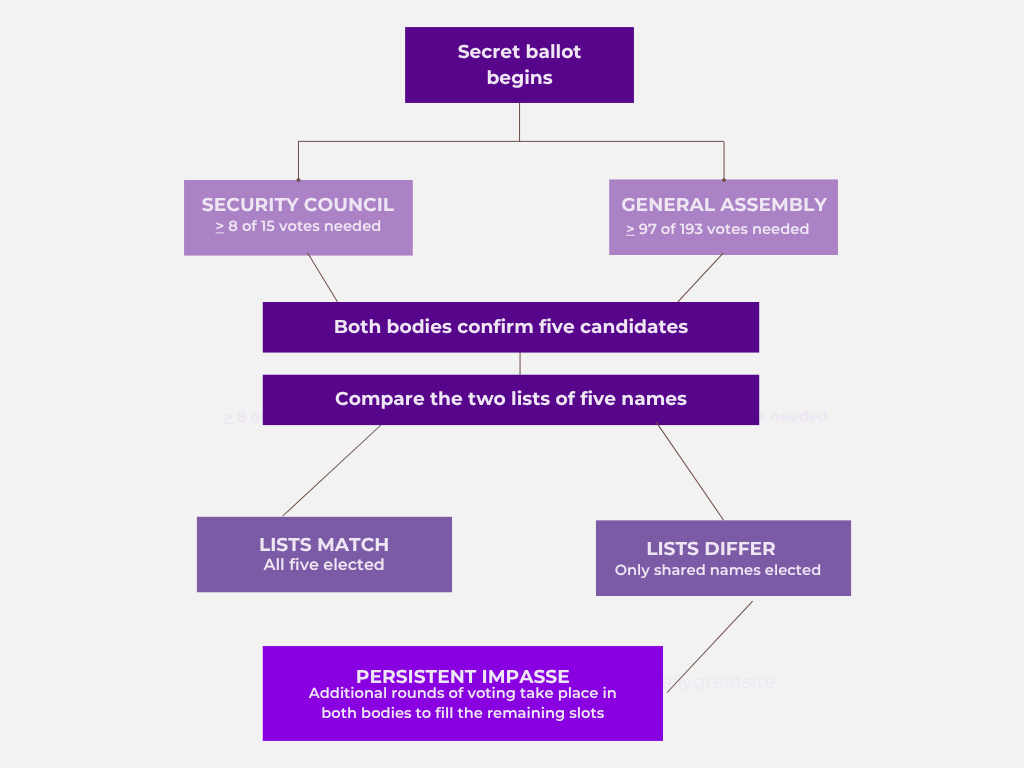
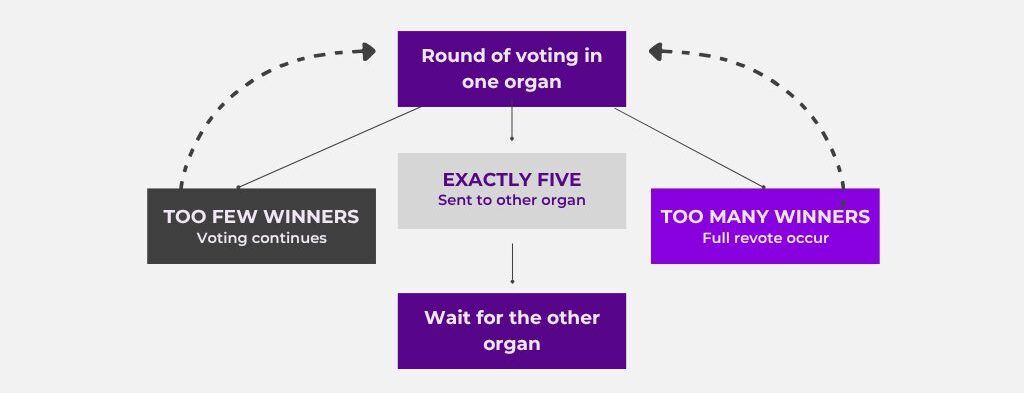
In each body, five and only five candidates must obtain the required majority. So, if, for example, only four candidates receive the required majority in one of the organs, the voting will continue until five and only five candidates have received the required majority. Likewise, if more than five candidates receive the required majority in an organ, there will be a new vote on all of the candidates until five and only five candidates have received the required majority.
Only when five candidates receive the required majority in one of the organs will the President of that organ notify the President of the other organ of the names of the five candidates. The President of the other organ will not communicate any names until it has also given five candidates the required majority of votes. Once five names have received the required majority in both the Security Council and the General Assembly, the lists of five are compared. If the same five candidates have received the required majority in both organs, then all five candidates will be considered to have been elected. However, if the names do not all match, then only those that have gained the required majority on both lists will be considered elected. The Security Council and the General Assembly will then proceed to additional rounds of simultaneous voting for those seats that were not filled.
No Formal Regional Allocation of Seats and Recent History
Unlike in many other UN elections, there are no formal regional designations for seats on the ICJ. While there have sometimes been informal understandings that some seats have historically been occupied by, e,g., an African judge or an Asian judge, this allocation has been only by practice and not rule. Recent history has shown that the unusual process can lead to unexpected and even dramatic results.
The 2017 election was a dramatic nail-biter of an election. Traditionally, the ICJ included judges from all of the Permanent Five (P5) countries. In 2017, Judge Christopher Greenwood of the United Kingdom was running for re-election. Judge Dalveer Bhandari of India was also running for re-election. In a surprising development, Lebanon’s Permanent Representative to the UN, Nawaf Salam, received the required majority in both the Security Council and in the General Assembly. In effect, Ambassador Salam had been elected to an “Asian seat” on the Court. Judge Greenwood received the required majority in the Security Council and Judge Bhandari received the required majority in the General Assembly. There followed a battle between the two, including eleven rounds of simultaneous voting in the General Assembly and the Security Council over more than one day. Ultimately, the UK withdrew Judge Greenwood’s candidacy and Judge Bhandari was elected. In some observers’ eyes, the battle was seen as a contest between rising India versus a post-Brexit UK—between a democratic, representative General Assembly versus an undemocratic, outdated Security Council; and between the developing world versus the developed world. It was a jolt to many that a permanent member of the Security Council had “lost” a seat on the ICJ.[2]
The 2017 result also showed that despite the requirement of agreement on candidates in the General Assembly and the Security Council (and thus the theoretical equal standing of both), the political reality is that if a candidate has the required majority in the General Assembly, it would be difficult for a candidate who only received the required majority in the Security Council to cling onto that partial victory to prevail in the end. Indeed, a similar dynamic had played out in 2014, within the Latin American and Caribbean region, when Patrick Robinson of Jamaica consistently won the required majority in the General Assembly while Susana Ruiz Cerutti of Argentina consistently won the required majority in the Security Council. After several rounds of voting, with Robinson’s General Assembly vote tally increasing with each vote, Argentina in the end withdrew its candidate.
The ICJ statute actually includes a special process to select a candidate in the event of an impasse. It provides that, if after three rounds of voting one or more seats remains unfilled, the General Assembly and the Security Council may at any time, at the request of either organ, form a joint conference consisting of six members, three appointed by each organ. This joint conference may, by an absolute majority, agree upon one name for each seat still vacant and submit the name or names for the acceptance of the Security Council or the GA. If the joint conference is unanimously agreed, it may submit the name of a person not included in the list of nominations. To date, the General Assembly and the Security Council have not resorted to establishing a joint conference to break a logjam in an ICJ election, though there was some consideration of this possibility during the 2014 and 2017 election impasses. While the Security Council or the General Assembly could have elaborated further guidelines on the joint conference process during years when there is no immediately pending election, they have not done so, in part because the momentum tends to dissipate once an election has been concluded. In addition, as noted above, the tendency is for the candidate and their country leading only in the Security Council to ultimately defer to the will of the General Assembly and to withdraw. It is unlikely that the General Assembly membership would want to breathe life into the joint conference process, because this process would serve to diminish the power of the General Assembly to choose an ICJ candidate.
The recent history echoes other trends of the General Assembly asserting its authority in areas where the Security Council has jurisdiction, such as in the adoption of the “Veto Initiative” in which the General Assembly automatically holds a debate every time a veto is cast in the Security Council, in the convening of the Emergency Special Session on Ukraine and the adoption of numerous General Assembly Ukraine-related resolutions and in the transparency measures the General Assembly has adopted with regard to the Secretary-General election process.
Co-Nomination Process
There is another relatively arcane aspect of the ICJ election process: Candidates are not formally nominated by member states. Rather, the ICJ Statute requires that candidates by nominated by “national groups” of the Permanent Court of Arbitration. While in some countries national groups include at least one member who is with the foreign ministry, in some countries only academics and other jurists who are not formally connected to the foreign ministry are on the national group. So, technically, an ICJ candidate is not always necessarily a candidate put forth by the member state itself. However, for practical purposes, a candidate is extremely unlikely to be elected if the candidate is not robustly supported by the government of that candidate’s country. In recent years, there has been an accelerating trend of “co-nominations.” National groups of countries other than the nationality of the candidate may also nominate that candidate. Co-nominations can be an indication of broad cross regional support for that candidate.
The 2026 Candidates and Their Campaigns
This year’s election features ten candidates for five open seats. Three sitting judges are not running for reelection: Ronny Abraham of France, Leonardo Nemer Caldeira Brant of Brazil, and Dalveer Bhandari of India. Following, in alphabetical order, are the candidates’ names, nationalities and number of national group nominations: (see Note by the Secretary-General, Election of members of the International Court of Justice: list of nominations by national groups, A/81/118-S/2026/525).
- Dapo Akande, United Kingdom, 43 nominations
- Francois Alabrune, France, 40 nominations
- Taoheed Olufemi Elias, Nigeria, 2 nominations
- Mahmoud Daifallah Hmoud, Jordan, 15 nominations
- Luz del Carmen Ibanez Carranza, Peru, 2 nominations
- Charles Chernor Jalloh, Sierra Leone, 13 nominations
- Rena Lee, Singapore, 33 nominations
- Phoebe N. Okawa, Kenya, 26 nominations
- Jin-Hyun Park, Republic of Korea, 21 nominations
- Marcelo Vazquez-Bermudez, Ecuador, 10 nominations
The candidates are undoubtedly engaging in strenuous campaigns.[3]
Foreign ministries and UN missions typically have election teams that are dedicated to their candidate’s election, including ambassadors, legal advisers and election officers. ICJ campaigns focus on numerous bilateral meetings with as many UN missions as possible, preferably at the Ambassadorial level. These New York meetings are often held in one of the prime meeting venues at the UN Headquarters—the high-ceilinged Delegates Lounge furnished with a multitude of couches and comfortable chairs. . Also, in a gesture of respect, candidates frequently meet with UN ambassadors at their missions, which are mostly located at various venues in and around Turtle Bay in New York. Candidates may also meet with foreign ministry officials in capitals to the extent resources for travel are available. In addition, UN missions frequently host receptions in New York featuring the candidates. Candidates also try to get on as many panel discussions in New York as they can, in order to enhance their visibility to member states and become well known to mission legal advisers.
ICJ campaign managers are keenly aware of the requirement to receive a majority of votes both in the Security Council and the General Assembly. As recent history has shown, candidates cannot rely primarily only on a strong showing in the Security Council if they do not have a solid vote count in the General Assembly. Campaigns try to secure as many voting commitments in writing as possible. Alas, as in all UN secret ballot elections, they need to be aware of a “discount factor,” as the actual number of votes received sometimes falls well short of the number of commitments that have been made in writing.
Unfortunately, unlike the UN Secretary-General selection process, there are no public dialogues with the candidates and no opportunities for civil society to ask questions of the candidates.
Given the vital importance of the ICJ, it is recommended that transparency measures be adopted for ICJ elections in the future. For example, the Sixth Committee (the General Assembly’s Legal Committee) could organize dialogues where all candidates could present themselves and their qualifications and could be asked questions at a public, webcast forum. Such a process could be memorialized through the biannual process on the revitalization of the General Assembly.
Election Day: November 3, 2026
With so many candidates competing for only five slots, things could be quite unpredictable on November 3. For example, in 2023, there were nine candidates competing for five slots. Given past experience, many delegates were bracing for multiple rounds of voting in the General Assembly. To everyone’s surprise, the General Assembly voted for five and only five candidates on the first round of voting. So, all eyes fell on the Security Council. It took five rounds of voting in the Security Council to reach five candidates. Because these five were the same candidates chosen by the General Assembly, no additional rounds were needed and the election concluded in one day.
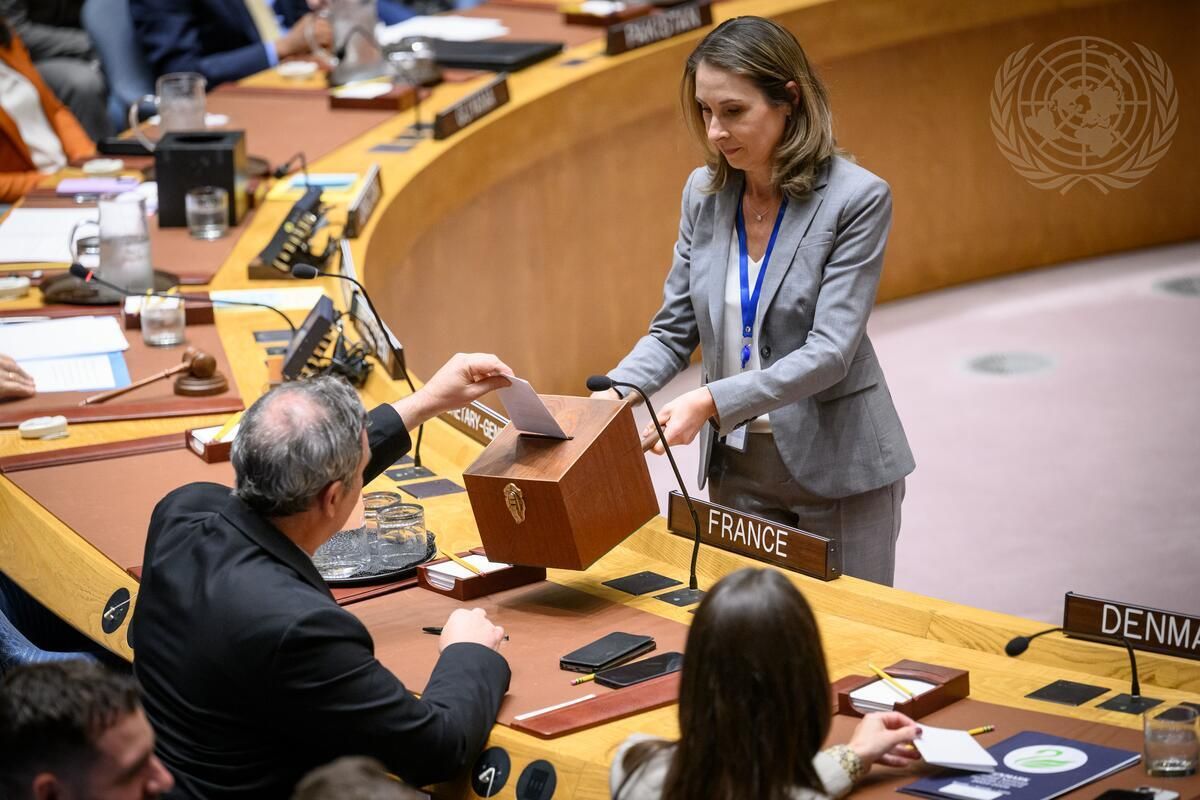
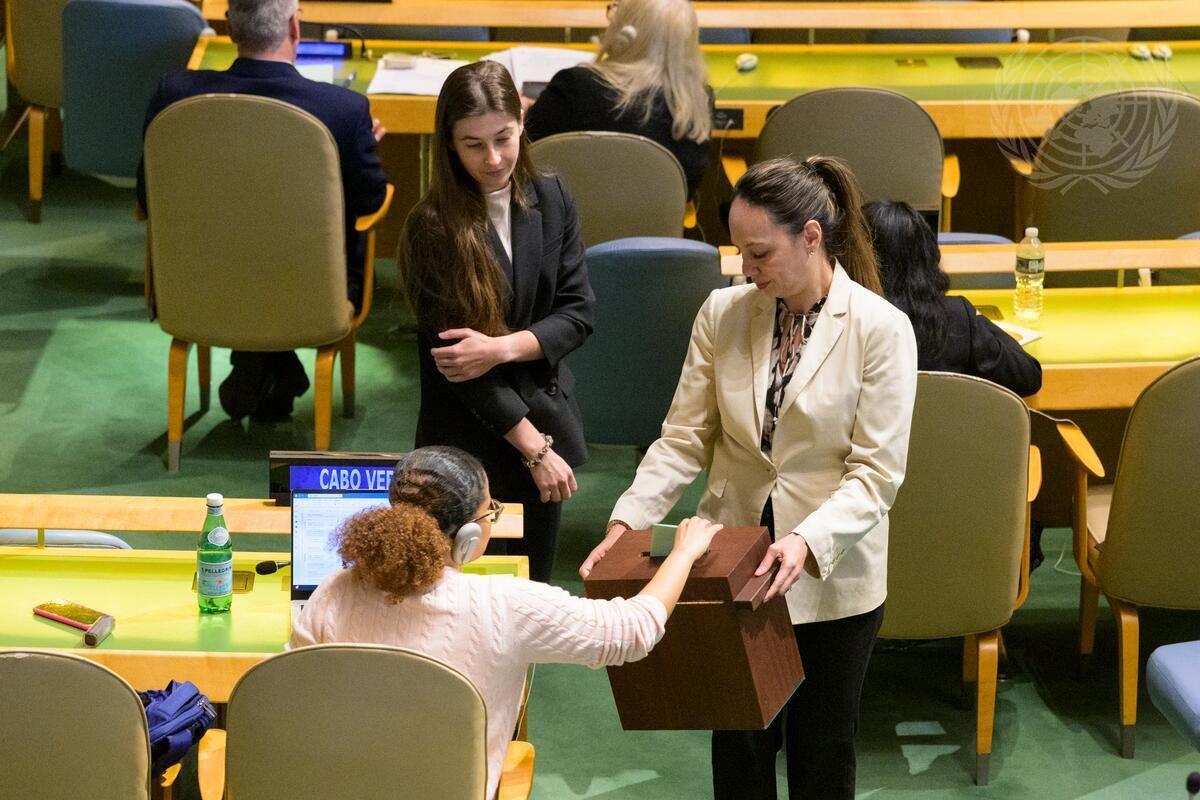
On election day, member states provide “tellers” to observe the vote-counting. After delegates have marked their votes on the paper ballots that have been distributed to them, Secretariat staff and tellers go from delegate table to delegate table with a large wooden box with a slot in the top, and delegates drop the folded secret ballots into the wooden box. (It all feels very nineteenth century in this high-tech age). Delegates and UN-watchers need to brace themselves for long periods of vote-counting, as tellers and Secretariat staff go behind closed doors to carefully tally the votes after each round. Vote-counting in the General Assembly could take up to an hour for each round. Those delegations with seats in the Security Council need to be prepared to have two teams to cast their respective votes in the General Assembly Hall and in the Security Council Chamber. While a quiet hush tends to fall on the Security Council in a relatively empty Chamber, there usually is a bit more of a buzz of conversation in the General Assembly Hall, as delegates catch up, and sometimes even take the opportunity to engage in very informal bilateral negotiations of Sixth Committee resolutions, as the Sixth Committee meetings will be moving towards their final weeks as of the time of the election. Still, all delegations are expected to stay in or by their seats, as the voting results could be announced at short notice, and another round of voting could occur depending on the results.
Conclusion
The ICJ is increasingly grappling with the most significant and controversial international law issues of the day. It is in the interest of everyone in the international community to closely follow the ICJ election. The five judges elected to nine-year terms will play an important role in shaping international law in the coming decade. It is hoped that this explainer sheds some light on the process to elect these five judges.
[1] This description is drawn from the Memorandum of the Secretary-General for the 2023 election, which itself draws from the ICJ Statute. See A/78/97-S/2023/445 (July 7, 2023), https://www.securitycouncilreport.org/atf/cf/%7B65BFCF9B-6D27-4E9C-8CD3-CF6E4FF96FF9%7D/S_2023_363.pdf.
[2] It is worth mentioning that another P5 incumbent failed to be reelected in 2023. Judge Kirill Gevorgian of Russia was not elected and Bogdan Aurescu of Romania was elected. This result was widely interpreted as a rebuke to Russia in response to its 2022 full-scale invasion of Ukraine.
[3] Elias and Carranza appear not to be mounting robust campaigns.
Top photo: “A Conference Officer collects ballots during the Security Council meeting that held an election of a member of the International Court of Justice.” May 2025. © UN Photo/Loey Felipe
Related Resources
-
-
When the General Assembly Votes for its President
This policy brief explores “politically governed authority," or real influence, constrained in form and scope by the preferences of the member states that constitute the institution. It proceeds through selection, function, capacity, and reform and uses the framework established in United Nations resolution 79/327, operative paragraph 49, to organize the implications of this design across four dimensions: efficiency, accountability, transparency, and institutional memory.
Stay Connected
Subscribe to our newsletter and receive regular updates on our latest events, analysis, and resources.
"*" indicates required fields