Selecting the Next United Nations Secretary-General: Power, Legitimacy, and the Design of the UN Highest Office
An earlier version of this piece was published in German in the German Review on the United Nations, no. 4 (2026), titled “Höchstes UN-Amt: Legitimität, Macht und Gestaltungskraft” (August 2026).
The United Nations (UN) is selecting its next Secretary-General amid intensifying pressure on multilateral norms. Under Article 97 of the UN Charter, the Security Council recommends a candidate for the General Assembly to appoint. Since 2015, transparency reforms have expanded visibility in the General Assembly without redistributing decision-making authority. Public competition now layers over a design set out in 1946 in which the Secretary-General was to be received by acclamation. The 2026 cycle tests whether General Assembly scrutiny, now an established feature of the selection process, can continue to reinforce convergence between legitimacy and decision under more adverse political conditions.
In 2026, the United Nations (UN) membership will select and appoint its tenth Secretary-General, at a moment of acute institutional strain: geopolitical polarization, an ongoing financial crisis, and renewed pressure on multilateral norms. The UN Charter establishes a formally simple rule for the appointment: the General Assembly acts upon the recommendation of the Security Council.[1] This means the appointee must be acceptable to the Security Council’s permanent members, yet credible to the membership that gives the office political authority. These two requirements do not always point towards the same candidate. Eighty years of institutional practice have built an elaborate structure around that rule without displacing it. Authority is primarily filtered through the Security Council, while legitimacy is increasingly constructed through visible procedures involving the wider UN membership. Since 2015, reforms have expanded transparency without altering the underlying constitutional gate. The 2026 cycle will test how far these reforms have reshaped expectations around the selection process without redistributing decision-making power. Understanding that tension is the purpose of this article.
The Gate: Article 97 and Great-Power Consent
Formally, under Article 97 of the UN Charter, the General Assembly appoints the Secretary-General on the Security Council’s recommendation. The Security Council’s recommendation is therefore decisive and has granted the Council a gatekeeping function that solidified over time into a filtering logic. The process rewards candidates capable of navigating great-power sensitivities, not because they command the broadest support across the membership. Competence and judgment matter, but they are assessed without shared standards: the Council has never agreed on what competence means for this office, and resists doing so. Each permanent and elected member applies their own criteria, and the absence of agreed benchmarks is what makes convergence around a single name possible.
Historical episodes illustrate both the necessity and the limits of this design. Trygve Lie, the first Secretary-General (Norway), was selected in 1946 as a compromise candidate, but his support for UN intervention in Korea led the Soviet Union to withdraw recognition, rendering the Secretariat politically constrained. The gate had secured his appointment but did not guarantee sustained political support during his mandate. Dag Hammarskjöld, his successor (Sweden), was approached discreetly and accepted the role without public campaigning, reflecting the expectation, settled by 1953, that candidates should emerge through consensus rather than contestation.[2] During the tenure of U Thant, the third Secretary-General (Burma), the Soviet proposal to replace the single office with a three-person troika revealed that major powers considered institutional redesign when the balance of influence appeared threatened, but ultimately preserved the single-office model to avoid formalizing bloc divisions within the Secretariat itself.[3]
The constitutional gate has not moved since 1946. General Assembly resolution 11(I) of 24 January 1946 itself encouraged this configuration, inviting the Security Council to propose only one candidate and recommending that the General Assembly avoid debates on the nomination. The office derived legitimacy from broad acclamation around a single candidate, so that the Secretary-General would not enter office as the openly contested choice of one bloc against another.[4] Subsequent reforms have operated around it, modifying procedures, increasing visibility, and expanding participation, but they have not displaced the Council’s decisive role. Every Secretary-General has entered office acutely aware of the tension between the acceptability required to clear the gate and the authority required to exercise the office: the same powers that can block their appointment can also constrain their mandate.
Convergence Without Transparency in the Security Council
The Charter does not specify how the Council should arrive at its recommendation. Members rely on iterative, confidential procedures designed to identify viable candidates without triggering overt confrontation. These practices are not codified, but arose and became institutionalized through repeated use across the previous selection cycles. Informal norms become institutionalized practice through repeated enactment; this process of institutional layering constrains future choices without altering the formal rules that govern the process.[5]
The legal foundation is Article 27 of the Charter, which requires any Council decision to receive affirmative votes from at least nine of its fifteen members, with no veto from any permanent member.[6] In the context of Secretary-General selection, this means a candidate must clear two distinct thresholds simultaneously: no opposition from any of the five permanent members, and sufficient support from the ten elected members to reach nine votes. The first threshold is decisive; the second ensures that the process cannot be reduced to a bilateral exchange between the five permanent members and the candidates. Elected members cannot override a veto, but their influence operates within the filtering logic: they can withhold the nine votes a candidate needs, shape the sequencing of convergence, and signal regional legitimacy.
The informal machinery for managing the two legal thresholds emerged from the 1981 deadlock. Kurt Waldheim of Austria sought an unprecedented third term; China vetoed him across sixteen rounds. Salim Ahmed Salim of Tanzania commanded majority support among elected members but faced a United States veto. After weeks of impasse, the Council president at the time, Ambassador Olara Otunnu of Uganda, distributed survey forms to all fifteen members: permanent members received a blue form asking which candidates they would “discourage”; all fifteen received a white form asking which they would “encourage.” Javier Pérez de Cuéllar of Peru emerged as generally acceptable and was elected Secretary-General on December 11, 1981.[7] The practice evolved into the straw poll system used in every subsequent selection: successive rounds of informal ballots in which Council members indicate “encourage,” “discourage,” or “no opinion.”
In 1991, color-coded ballots were introduced to distinguish permanent and elected members within the straw poll rounds. A “discourage” vote from a color-coded permanent-member ballot is the functional equivalent of a likely veto: it signals that a candidate cannot survive a formal vote without triggering it. The mechanism functions as a veto anticipation system.
In 1996, these practices were set down on paper for the first time as the Wisnumurti Guidelines, named after Ambassador Nugroho Wisnumurti of Indonesia, and immediately put through the test.[8] Boutros Boutros-Ghali of Egypt was seeking a second term with broad support among the wider membership, but the United States exercised a formal veto against him, becoming the first permanent member to block a sitting Secretary-General from reappointment.[9] Four new candidates entered the race, and the Council held both undifferentiated and color-coded straw polls on the same day, until Kofi Annan of Ghana emerged as the consensus candidate.
In 2016, six rounds of straw polls gradually filtered the 13 candidates, and António Guterres emerged as the consensus front-runner.[10] The public phase had generated significant attention and normative expectations around gender representation and regional rotation. The selection outcome reflected Security Council convergence rather than those expectations.
Across these episodes, a consistent pattern emerges: moments of deadlock or contestation have not led to formal reform, but to informal adaptations that preserved the underlying distribution of authority. The system evolves by absorbing pressure rather than by redistributing power. In the Security Council, candidates advance primarily by surviving successive rounds of filtering. Deliberations are therefore geared towards identifying candidates capable of avoiding a veto rather than those with the strongest vision or the broadest support.
Transparency Without Authority in the General Assembly
Since 2015, the General Assembly has constructed a procedural framework aimed at introducing positive criteria, competence, vision, and public accountability into a process structurally dominated by filtering.[11] The reform trajectory reflects institutional layering rather than redesign: successive adjustments have expanded visibility without redistributing decision-making authority. Each reform has responded to specific institutional pressures rather than a coherent program of change.
General Assembly resolution 69/321 (2015) introduced the foundational elements: a joint letter inviting nominations, publication of candidate names and curricula vitae, vision statements, and public interactive dialogues with candidates.[12] These measures created a visible pre-selection stage in which candidates present their priorities and respond to questions from member states and civil society. General Assembly resolution 75/325 (2021) illustrates the reactive logic that has governed subsequent reforms. Rather than extending the transparency framework by design, it closed a gap the framework had failed to anticipate. A UN staff member’s attempt to self-nominate without member state backing exposed the absence of a formal eligibility requirement, and the Assembly legislated in response.[13]
General Assembly resolution 79/327 (2025) consolidated the framework for the 2026 cycle, introducing clearer timelines, a limit of one nomination per member state, campaign financing disclosure, guidance on conflicts of interest, and a dedicated public platform for candidate information.[14] Proposals that would have redistributed authority, including General Assembly straw polls, multi-candidate Security Council recommendations, a single non-renewable term, and binding gender provisions, were discussed and set aside. Security Council deliberations remain confidential.
One structural gap the reforms have not addressed concerns the criteria for evaluating candidates. The resolutions specify procedural requirements to make candidates more visible (e.g., disclosure, timelines, and eligibility conditions), but they do not define the competencies expected of the Secretary-General, the standards against which vision statements should be assessed, or the basis on which member states should express preferences during the dialogues. Without agreed criteria, the public dialogues can reveal performance but cannot discipline preference formation.
The 2016 selection demonstrated both the impact and the limits of the transparency approach. Thirteen candidates participated in extensive public dialogues, generating unprecedented visibility. Gender representation and regional rotation emerged as publicly salient expectations. The eventual selection of António Guterres reflected Security Council convergence rather than these expectations. The transparency process helped legitimize the outcome: member states and civil society had been visibly consulted, even though the result did not reflect their expectations. The General Assembly has become an increasingly important source of legitimacy within a selection process whose decisive authority remains with the Security Council: transparency has raised the political and reputational cost of ignoring the public phase. It has reshaped the environment in which candidates campaign and in which Council members deliberate, even though it has not transferred deliberative authority from the Council to the Assembly. The General Assembly’s post-2015 framework has thus given visibility to a process whose decisive moments remain elsewhere.
The 2026 Cycle: Between Legitimacy and Decision
The 2026 cycle unfolds in a markedly different political environment from 2016. The 2015 reforms were introduced in a period of multilateral aspiration and procedural novelty; the framework was tested in 2016 against a candidate field that included serious contenders and a Council prepared to converge.[15] That context has since narrowed: deeper geopolitical rivalry, weaker multilateral consensus, and an acute financial crisis raise both institutional pressure and political risk for any incoming Secretary-General. In 2016, the public phase generated legitimacy and the Council’s eventual choice was broadly accepted because António Guterres had emerged as the clear front-runner through the public dialogues. Whether that alignment between public engagement and Council convergence can be reproduced under present conditions is the central question the 2026 cycle poses.
The 2026 selection process formally opened with the joint letter issued by the Presidents of the General Assembly and the Security Council on November 25, 2025,[16] inviting member states to present candidates and setting out the procedures established under Resolution 79/327.
Five candidates were formally nominated ahead of the interactive dialogues the General Assembly convened on April 21 and 22, 2026. Argentina nominated Rafael Grossi, Director General of the International Atomic Energy Agency, in November 2025. Michelle Bachelet, former President of Chile and former UN High Commissioner for Human Rights, was nominated jointly by Chile, Brazil, and Mexico in February 2026, but Chile withdrew its support on March 25 (the framework does not require home-state nomination). Virginia Gamba, a former UN Special Representative for Children and Armed Conflict, was nominated by the Maldives in March 2026 but dropped out of the race when the Maldives withdrew its nomination, as she had no other supporting state. Macky Sall, former President of Senegal and former Chair of the African Union (AU), was nominated by Burundi in March 2026 outside the AU’s established candidature process. Burundi’s subsequent attempt to secure continental endorsement through a silence procedure with a twenty-four-hour deadline failed on March 27 when twenty member states broke the silence, including Senegal itself and Nigeria, which recalled in its note verbale that “it is the turn of South America and the Caribbean region to produce the next UN Secretary-General.” Costa Rica nominated Rebeca Grynspan, Secretary-General of UN Trade and Development, in March 2026.
Resolution 79/327 sets no deadline for nominations, allowing candidates to enter the race after the initial dialogues. As of this writing, this has occurred twice. On May 11, 2026, Antigua and Barbuda nominated María Fernanda Espinosa Garcés, former President of the General Assembly. On June 15, 2026, Guyana nominated Carolyn Rodrigues Birkett, Ambassador and Permanent Representative of Guyana to the UN. The Security Council has confirmed that all candidates, regardless of nomination date, will be afforded both a General Assembly dialogue and an informal Council meeting, extending to late entrants the same scrutiny framework applied to the initial field.
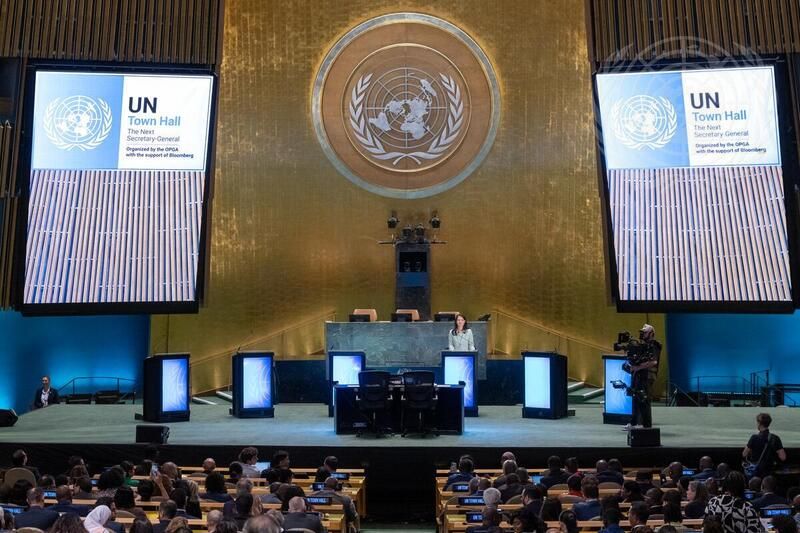
On April 21 and 22, 2026, four candidates participated in three-hour interactive dialogues at UN Headquarters, convened by General Assembly President Annalena Baerbock. Grossi argued for technical credibility and institutional management capacity in a contested multilateral environment. Bachelet centered her platform on human rights and the prospect of being the first woman to hold the office. Grynspan presented a development finance agenda aligned with the priorities of a majority of member states. Sall focused on African representation and global governance reform. Three of the four candidates are women, and three are from Latin America and the Caribbean, the region conventionally considered next in the informal rotation. The dialogues were broadcast live in all UN official languages and attracted significant civil society attention.
The dialogues were more structured than in 2016: sessions were extended from two to three hours, civil society was included, and time management was stricter. Candidates were required to respond to each question individually, which produced mixed effects: they could not avoid sensitive issues, but had limited time for substantive or consolidated answers and delivered prepared talking points. Clustering questions also gave groups greater visibility relative to individual member states, but many interventions emphasized institutional priorities over substantive questioning, making the exchanges less dynamic.
The dialogues produced no formal ranking, no agreed assessment of candidates’ qualities, and no binding signal to the Security Council. Their function was to expose all candidates to a common standard of public scrutiny, not identify the best candidate or produce a ranking. All four candidates converged on similar themes: restoring trust in the multilateral system, the need for reform, and the importance of the Secretary-General’s role as a mediator. The next phase of informal meetings with Council members is expected to begin between July 24 and 30, 2026. Candidates will face more probing scrutiny of their actual positions.
Even within the Council, the dynamics remain uncertain. A revealing dynamic has emerged around the publication of straw poll results, the main area where the Security Council could improve the transparency of its process. The debate is no longer between “publicity or confidentiality,” but between “organized publicity or leaks,” which are now near-certain. Despite Japan’s appeal in 2017,[17] most current elected members remain reluctant to publicize straw polls. France’s presidency of the Security Council in September 2026 thus carries particular weight: it falls during the General Assembly High-level Week, when political attention is concentrated, and pressure to advance towards a recommendation is highest.[18]
The result is an increasingly integrated process: a legitimacy phase centered on the General Assembly and a selection phase centered on the Security Council. One generates public scrutiny and political legitimacy; the other produces the formal recommendation. The two functions remain institutionally distinct, but the 2026 cycle suggests General Assembly scrutiny has become more firmly embedded in the overall selection process than in previous decades.
Whether the 2026 process can produce a recommendation, and whether that recommendation will carry political authority, depends on Security Council dynamics that Resolution 79/327 was never designed to reach.
Legitimacy Without Authority: An Unresolved Tension
The selection of the Secretary-General combines a fixed structure of authority with an evolving architecture of legitimacy. Under Article 97 of the Charter, the Security Council recommends, and the General Assembly appoints: both roles are formally indispensable. However, the constitutional gate has remained structurally unchanged since 1946: reforms since 2015 have strengthened the legitimacy dimension without altering this formal distribution. The process functions as a mechanism of managed convergence rather than open competition. Since 1946, the General Assembly has retained the authority to refuse the candidate recommended by the Council, but has never operationalized it. The cost of refusal (institutional deadlock and divisions among the major powers) has always exceeded what any membership coalition was prepared to bear. The process functions as if the Council were institutionally decisive because the Assembly has never found the conditions under which acting otherwise was worth the consequences. Its primary purpose is to secure a candidate sufficiently acceptable across the major powers, and within the wider membership, to be appointed without contestation.
Reforms have expanded legitimacy without redistributing authority. The General Assembly has built a procedural architecture (dialogues, disclosures, and public candidate fields) that raises the reputational cost of ignoring membership preferences but does not redistribute the power to decide. Public competition has been layered over a structure built for ratification by acclamation: every Secretary-General since 1946 has been appointed by consensus or acclamation, never by contested vote. This asymmetry has been actively maintained: members who otherwise accept the General Assembly framework have consistently resisted proposals to extend transparency to the Council itself (for instance, by publishing straw poll results) or to expand the General Assembly’s role in deliberation.
The 2026 cycle suggests that engagement with the General Assembly has become an expected component of every serious candidature, even as decision-making authority remains concentrated in the Security Council. Despite heightened geopolitical tensions and weakened multilateral consensus, the Security Council confirmed that all candidates, regardless of nomination date, would be afforded both a General Assembly dialogue and an informal Council meeting. General Assembly scrutiny has been incorporated into the selection process without reopening the constitutional bargain of 1946.
A structural tension nevertheless persists between the acceptability required to clear the constitutional gate and the authority required to exercise the office. The 2026 cycle sharpens that tension without resolving it: a more polarized environment makes it harder for a Secretary-General to gradually build political authority, while making the legitimacy of the selection process itself more important. The process is designed to produce a candidate the major powers can accept, not to identify the leader the moment requires. In 2026, as in 1946, whether those two specifications converge remains a question of political circumstance rather than institutional design.
[1] Charter of the United Nations, Article 97, San Francisco 1945.
[2] Dag Hammarskjöld reportedly believed the telegram informing him of his selection as the second Secretary-General was an April Fool’s joke: the Security Council recommended him on March 31, 1953, without prior consultation or campaigning.
[3] The Soviet troika proposal was advanced in 1961 following the death of Dag Hammarskjöld. See Brian Urquhart, Hammarskjold, New York 1972, p. 596.
[4] UN General Assembly, “Terms of Appointment of the Secretary-General,”A/RES/11(I), January 24, 1946, operative paragraph 4(d): “it would be desirable for the Security Council to proffer one candidate only for the consideration of the General Assembly, and for debate on the nomination in the General Assembly to be avoided. Both nomination and appointment should be discussed at private meetings, and a vote in either the Security Council or the General Assembly, if taken, should be by secret ballot.”
[5] Vincent Pouliot, “Historical Institutionalism Meets Practice Theory: Renewing the Selection Process of the United Nations Secretary-General,” International Organization (IO), 74. Jg., 4/2020, S. 742–772, doi.org/10.1017/S002081832000020X.
[6] Charter of the United Nations, Articles 27(2) and 27(3), San Francisco 1945.
[7] Francesco Mancini, “Vetoes, Zombie Candidates, and the Lowest Common Denominator: Selecting the UN Secretary-General”, IPI Global Observatory, October 5, 2016, https://theglobalobservatory.org/2016/10/united-nations-secretary-general-straw-poll-antonio-guterres.
[8] Loraine Sievers and Sam Daws, The Procedure of the UN Security Council, 4th edition, Oxford 2014, p. 379.
[9] UN Security Council, S/PV.3714, November 19, 1996.
[10] Security Council Report, “The UN Secretary-General Selection and Appointment Process: Emerging from the Shadows,” 2017 No. 3, April 4, 2017.
[11] Mark Simonoff and Thibault Camelli, “The Process for Selecting the Secretary-General of the United Nations,” NYU Center on International Cooperation, October 8, 2025, https://cic.nyu.edu/resources/the-process-for-selecting-the-secretary-general-of-the-united-nations.
[12] UN General Assembly, A/RES/69/321, “Revitalization of the work of the General Assembly,” September 11, 2015.
[13] UN General Assembly, A/RES/75/325, “Revitalization of the work of the General Assembly,” June 25, 2021. The self-nomination by Arora Akanksha, a UN Secretariat staff member in 2020 exposed the gap.
[14] UN General Assembly, A/RES/79/327, “Revitalization of the work of the General Assembly,” September 5, 2025.
[15] United Nations,.Joint-letter from the President of the General Assembly and the President of the Security Council on the selection and appointment of the next Secretary-General of the United Nations, A/80/544–S/2025/765, November 25, 2025.
[16] Security Council Report, Power, Process and Participation: The Search for the Next Secretary-General, Research Report No. 1, February 8, 2016, https://www.securitycouncilreport.org/research-reports/power-process-and-participation-the-search-for-the-next-secretary-general.php.
[17] United Nations, A/71/774-S/2017/93, “Identical letters dated 1 February 2017 from the Permanent Representative of Japan to the United Nations addressed to the Secretary-General and the President of the Security Council,” February 2, 2017, https://docs.un.org/en/S/2017/93.
[18] Denmark holds the Council presidency in August 2026, France in September, Greece in October, and Latvia in November. France’s September presidency coincides with the General Assembly high-level week, historically the period of greatest political pressure to advance towards a recommendation.
“UN Town Hall: The Next Secretary-General,” July 23, 2026 © UN Photo/Eskinder Debebe

Stay Connected
Subscribe to our newsletter and receive regular updates on our latest events, analysis, and resources.
"*" indicates required fields