The 20th International Policy and Planning Summit Climate, Migration, and Global Resilience
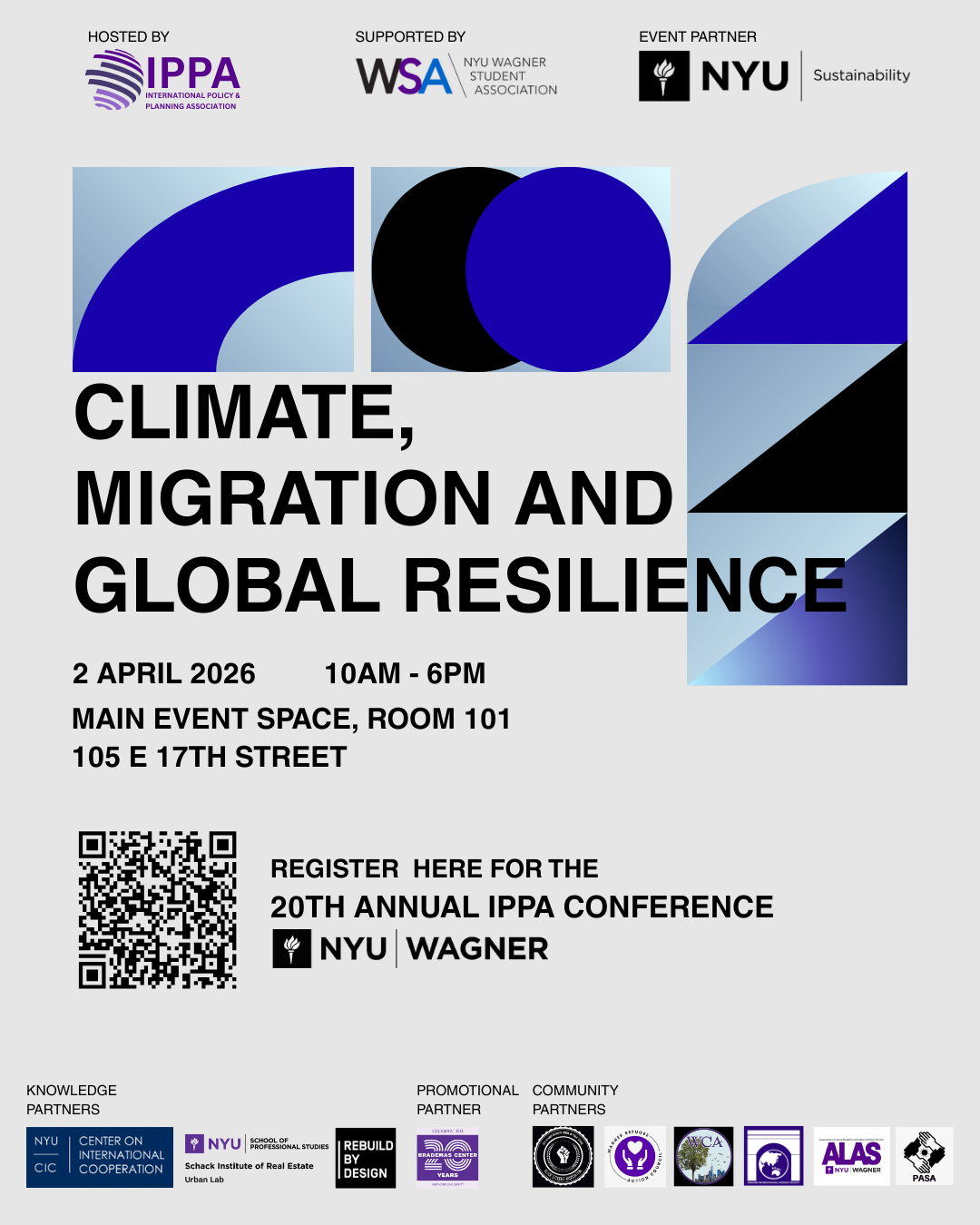
Join NYU’s Center on International Cooperation (CIC) at the upcoming 20th International Policy and Planning Summit, presented by the International Policy and Planning Association (IPPA).
This Summit brings students, academics, and practitioners to explore cross-sectoral solutions to the interconnected global challenges of climate change, migration, and global urban resilience.
Anchored at NYU Wagner, the summit will bridge academic research, applied policy, and practical implementation, offering experiential learning opportunities and reinforcing NYU’s position as a hub for global policy dialogue and innovation.
Welcome remarks will be given by Paul Smoke, NYU Wagner Graduate School of Public Service, and Director of the Center for International Cooperation; and Nate Edwards, Program Officer, CIC, will be moderating the morning panel on Informality, Infrastructure, and Integrating Climate Response.
Join CIC for our afternoon interactive breakout session: Balancing Climate Resilience and Urban Equity in Beira, Mozambique, from 2:30–3:30 p.m. This breakout session will be moderated by Themba Maheka, Associate Director; and Jeronimo Pareja-Cardona, Program Officer at CIC.
As climate risks intensify in coastal cities, governments are under increasing pressure to implement infrastructure that reduces exposure to floods and other hazards while ensuring that adaptation policies do not exacerbate inequality. This interactive workshop will explore the governance challenges that arise when climate resilience investments intersect with land tenure insecurity, informal settlements, and rapidly changing urban land markets. The session will use the case study of Beira in Mozambique, a low-lying coastal city pursuing flood protection and drainage improvements, while modernizing its land administration systems. In doing so, the session will examine how cities can pursue climate adaptation while safeguarding housing security and equitable development.
Participants will work in small breakout groups representing key stakeholder groups, including community representatives, municipal government, international partners and donors, and the real estate sector, to develop negotiating positions on a proposed flood-resilience investment affecting an area with informal housing. Through structured discussion and short presentations, groups will identify their priorities, red lines, and potential compromises while engaging with the perspectives of other actors involved in the project.
Stay Connected
Subscribe to our newsletter and receive regular updates on our latest events, analysis, and resources.
"*" indicates required fields