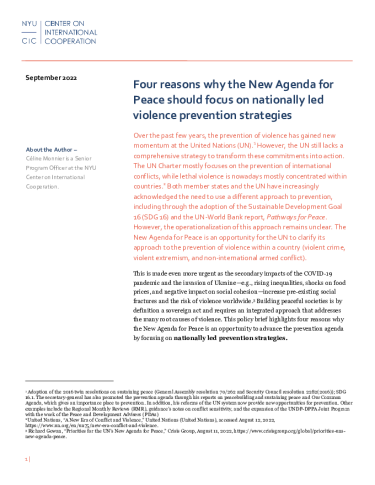
Over the past few years, the prevention of violence has gained new momentum at the United Nations (UN). However, the UN still lacks a comprehensive strategy to transform these commitments into action. The UN Charter mostly focuses on the prevention of international conflicts, while lethal violence is nowadays mostly concentrated within countries.
Both member states and the UN have increasingly acknowledged the need to use a different approach to prevention, including through the adoption of the Sustainable Development Goal 16 (SDG 16) and the UN-World Bank report, Pathways for Peace. However, the operationalization of this approach remains unclear. The New Agenda for Peace is an opportunity for the UN to clarify its approach to the prevention of violence within a country (violent crime, violent extremism, and non-international armed conflict).
The New Agenda for Peace is a key opportunity to give new momentum to nationally led prevention strategies. This policy brief looks at how these strategies are fertile ground to make progress on the UN prevention agenda for four reasons.
- First, in the current divided geopolitical context, nationally led prevention strategies benefit from strong support among member states across these divides
- Second, from a technical perspective, they are essential to reduce internal violence.
- Third, nationally led violence prevention strategies are not a new approach, but build on efforts that already take place in all countries.
- Lastly, the New Agenda for Peace is a good opportunity to focus on the nationally led prevention strategies because the UN is well-placed to help member states to address the main challenges that hinder progress on such strategies, namely national actors’ lack of cognizance regarding the benefits of nationally led prevention strategies; the lack of technical expertise to navigate the complexity of setting up such a system; and the lack of funding to develop a strategy.
Download the brief: Four reasons why the New Agenda for Peace should focus on nationally led violence prevention strategies