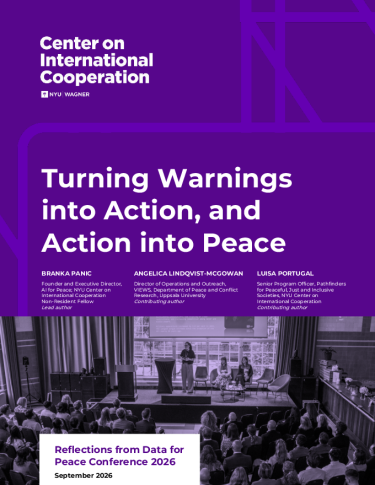
Reflections from Data for Peace Conference 2026

Turning Warnings into Action, and Action into Peace

Publication: Report

The Data for Peace Conference 2026 (June 15–17, Stockholm and online) brought together the research, technology, policy, and practitioner communities working on conflict prevention. Two in-person plenary days in Stockholm—attended by 150 participants on-site—were followed by a virtual day of parallel tracks that drew more than 1,500 registered participants. Session recordings from the three days have since generated over 1,800 unique views, and counting. Formats ranged from panels and lightning talks to workshops, peer-review clinics, and scenario simulations—designed not only to showcase what is technically possible but also to ask what is required for innovations to be applied responsibly and effectively, turning warnings into action and action into peace.

The Conference was co-hosted by the Department of Peace and Conflict Research at Uppsala University, the NYU Center on International Cooperation (CIC), and AI for Peace—with support from the Complex Risk Analytics Fund (CRAF’d), Folke Bernadotte Academy (FBA), and the Finnish Ministry for Foreign Affairs.

The Conference generated the richest body of content the Data for Peace initiative has produced to date, and no summary can do justice to the full breadth of what was shared across both in-person and virtual days. This is not a comprehensive account but a thematic synthesis—an attempt to trace the threads that connected sessions across three days, rather than a reflection of any single session’s full content. We begin by looking at where the field stands on peace and conflict data—how and whether AI is helping, where conflict modeling is headed, and whether the field is finally closing the gap between warning and action. We then turn to the harder questions: what trust, accountability, and political will are required to make warnings actionable—and who early warning systems ultimately serve and belong to.

For the full picture, we invite you to explore recordings of individual sessions on our YouTube channel or of the complete conference days (Day 1 and Day 2).
Related Resources

  • Publication: Report April 6, 2022 Data for Peace

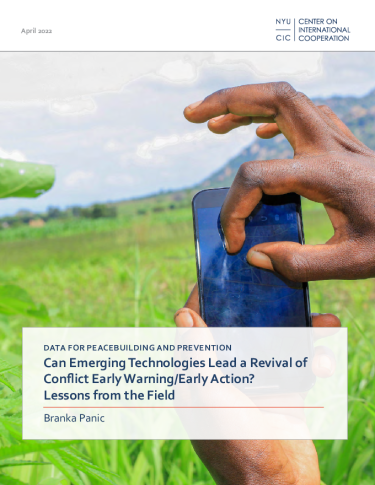
    Can Emerging Technologies Lead a Revival of Conflict Early Warning/Early Action? Lessons from the Field

    The early warning/early action (EWEA) community has been working for decades on analytics to help prevent conflict. The field has evolved significantly since its inception in the 1970s and 80s. The systems have served with variable success to predict conflict trends, alert communities to risk, inform decision makers, provide inputs to action strategies, and initiate a response to violent conflict. Present systems must now address the increasingly complex and protracted nature of conflicts in which factors previously considered peripheral have become core elements in conflict dynamics.

  • Publication: Report October 27, 2020 Data for Peace

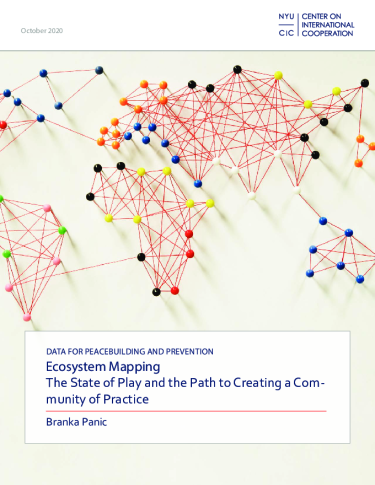
    Data for Peacebuilding and Prevention Ecosystem Mapping: The State of Play and the Path to Creating a Community of Practice

    How can cutting-edge approaches to data—like advanced data science methods, quantitative methods, predictive analytics, artificial intelligence (AI), machine learning (ML), and natural language processing (NLP)—help inform peacebuilding and conflict prevention? The report maps and analyzes the existing global ecosystem in the field of data for peace and prevention.

  • Publication: Report July 8, 2019 Data for Peace

    Data for Peace and Security: Report of the Practitioners Workshop on Harvesting Best Practices and Building a Community of Practice

    As the world faces a significant upward trend in conflict—including a tripling of civil wars since 2007 and conflict increasingly prevalent in middle-income countries—practitioners in peace and security have sought to expand their toolkits to take advantage of the revolution in information gathering, data analytics, ICTs, and machine learning. On March 20, 2019, participants from around the world showcased 25+ innovative, data-driven approaches that are transforming the methods and the effectiveness of those working on early warning, conflict prevention, peacebuilding, stabilization, and international security.

Stay Connected

Subscribe to our newsletter and receive regular updates on our latest events, analysis, and resources.

"*" indicates required fields

This field is for validation purposes and should be left unchanged.