NYU Migration Network Annual Conference: AI & Immigration Policy
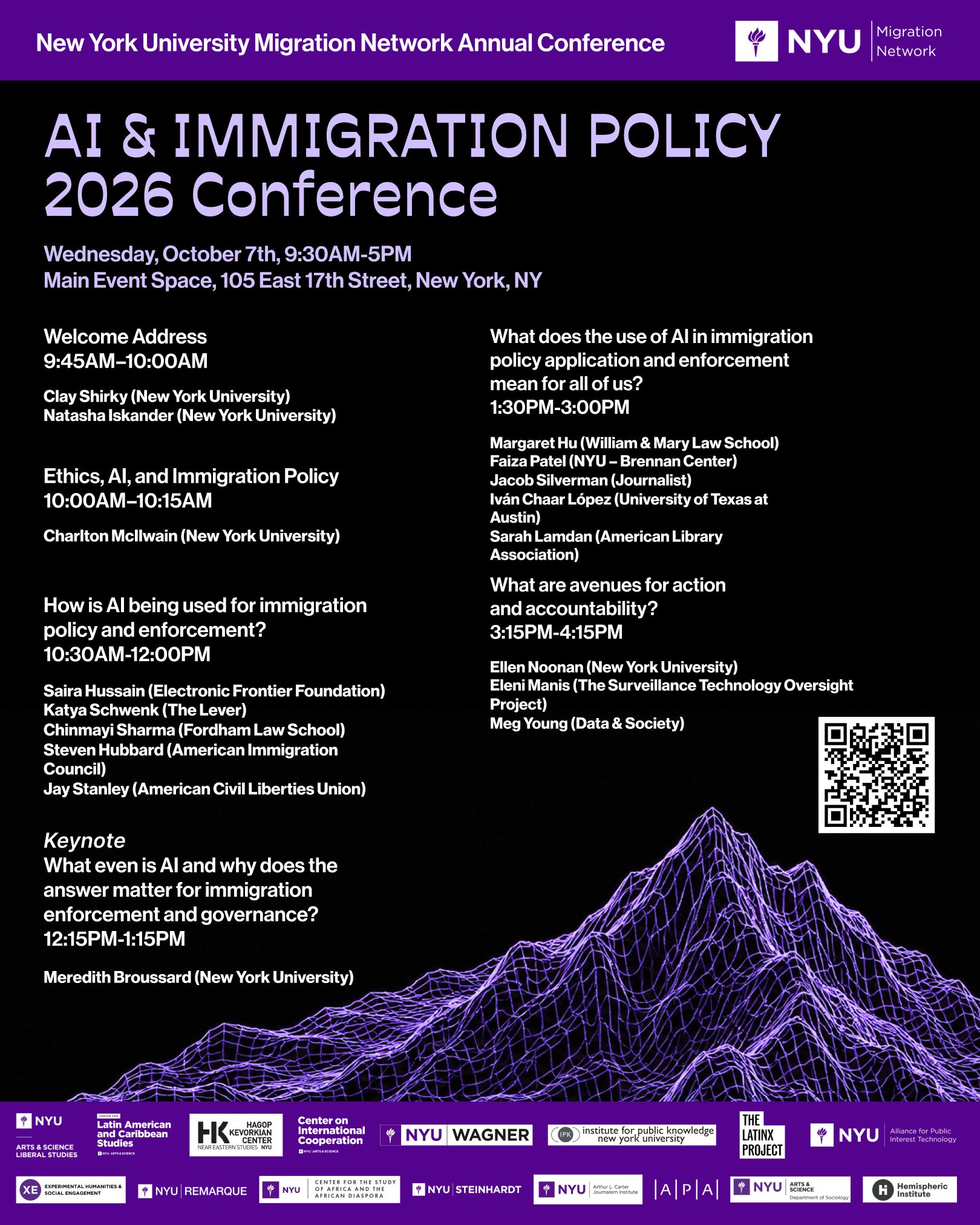
The NYU Center on International Cooperation (CIC) is pleased to co-sponsor the 2026 NYU Migration Network Annual Conference. Join us for a full-day event exploring the growing role of artificial intelligence (AI) in immigration policy and governance. Through expert panels and a keynote address, scholars, legal experts, policymakers, and advocates will examine how AI is reshaping immigration systems, enforcement, and decision-making, while addressing its ethical, legal, and human rights implications.
Welcome Address
Time: 9:45 AM – 10:00 AM EDT
Clay Shirky (New York University)
Natasha Iskander (New York University)
AI, Immigration, and Ethics
Time: 10:00 AM – 10:15 AM EDT
Charlton Mcllwain (New York University)
Panel #1: How is AI being used for immigration policy and enforcement?
Time: 10:30 AM – 12:00 PM EDT
This panel asks how AI systems are currently being used for immigration policy and enforcement. Together, the panelists will address the functionalities and use cases being developed and the data practices required for these technologies to proliferate. Discussions will center on the implications of this technology for immigration case adjudication. They will help us understand the major actors in this space, such as the leading technology companies and the influence of business interests in shaping immigration governance.
Featured Panelists:
Saira Hussain (Electronic Frontier Foundation)
Katya Schwenk (The Lever)
Chinmayi Sharma (Fordham Law)
Steven Hubbard (American Immigration Council)
Jay Stanley (American Civil Liberties Union)
Moderated by Natasha Iskander (New York University)
Keynote: What even is AI, and why does the answer matter for immigration enforcement and governance?
Time: 12:15 PM – 1:15 PM EDT – Lunch served
Keynote speaker: Meredith Broussard (New York University)
Our keynote will explore the essential question: what is AI, and how does it work? Speaker Meredith Broussard will illuminate different types of AI, such as natural language processing, machine learning, and agentic/embodied AI, and explore what we mean by “AI in governance.” She will address the social biases built into AI models and the historical context for AI’s growing use in immigration enforcement. This keynote sets AI in the context of other technologies that are used by the government, asking: how is AI different, and is it unique?
Introduced by De Angela L. Duff (New York University)
Panel #2: What does the use of AI in immigration policy application and enforcement mean for all of us?
Time: 1:30 PM – 3:00 PM EDT
This panel addresses the use of AI in immigration policy and governance more broadly. Our panelists will illuminate how AI systems have pushed the government into new functions, with few opportunities for appeal. They will outline new governance possibilities for data-driven, AI-powered surveillance, the integration of massive, disparate datasets from public, private, and government sources, and algorithmic decision-making. They will address what these changes mean for political rights and protections, especially privacy and civil liberties. These technologies are redefining public life and social categories of inclusion and exclusion along lines of race, gender, sexuality, immigration status, and others. Our panelists will conclude by exploring how we can reshape the use of AI to support democratic governance and political rights.
Featured Panelists:
Margaret Hu (William & Mary Law School)
Faiza Patel (NYU – Brennan Center)
Jacob Silverman. (Journalist)
Iván Chaar López (University of Texas at Austin)
Sarah Lamdan (American Library Association)
Moderated by Cristina Beltrán (New York University)
Panel #3: What are avenues for action and accountability?
Time: 3:15 PM – 4:15 PM – Coffee served
The last panel of the day asks leading researchers to help the audience understand where we fit into this picture. How do we interrogate and challenge uses of AI that cause harm? How can we act to ensure that AI systems are used for good governance and in support of civil rights and democratic principles? Panelists will explore the new ethical concerns raised by research—database or field research—in contexts shaped by AI-enabled surveillance capabilities.
Featured Panelists:
Ellen Noonan (New York University)
Eleni Manis (Surveillance Technology Oversight Project)
Meg Young (Data & Society)
Moderated by Radha S. Hegde (New York University)
Stay Connected
Subscribe to our newsletter and receive regular updates on our latest events, analysis, and resources.
"*" indicates required fields